Papyrus of Ani (1450 π.Χ.)
Source https://www.britishmuseum.org/collection/object/Y_EA10470-31
The Papyrus of Ani belongs to the large collection of Egyptian funerary texts conventionally known today as the Book of the Dead. This name is a modern one and does not accurately reflect the Egyptian title rw nw prt m hrw, which refers to coming forth or emerging into the light of day. For this reason, when referring to the Egyptian work itself, we consider “Emergence into the Light of Day” a more appropriate rendering.
This particular papyrus was produced around 1250 BCE, during the 19th Dynasty, for Ani, a high-ranking scribe who lived in Thebes. The texts it contains, however, were not created at that time. They belong to a much older tradition and already appear in earlier papyri of the 18th Dynasty, from approximately the 15th century BCE, while some of their elements have even older predecessors. The Papyrus of Ani should therefore be understood as an exceptionally rich and well-preserved copy of a tradition that had already existed for centuries.
The papyrus was discovered at Thebes and acquired in 1888 by the British Museum, where it is preserved today under the collection number EA10470. When discovered, it formed a single continuous roll approximately 24 metres long. After its acquisition, it was cut into separate sections. This division did not follow the boundaries of the chapters as they were later numbered and classified. As a result, some chapters are now divided between different plates. For the present publication, we have digitally joined the necessary sections of Plates XXXI and XXXII, so that the reader can view as a single continuous image the whole of Part 2 of Chapter 125 — the 42 Negative Confessions.
As a whole, the papyrus reflects the theology developed by the Egyptian priesthoods concerning death and posthumous existence, that is, the journey of the deceased after death: the deities and beings encountered, the dangers that must be overcome, the knowledge that must be possessed, the judgement of one’s actions, and ultimately the continuation of one’s existence.
From this extensive body of material, we chose to examine two specific passages in detail. The first is the 42 Negative Confessions of Chapter 125, because among them we encounter prohibitions concerning murder, theft, falsehood, perjury and adultery, which display striking correspondences with much later theological texts, particularly with certain of the Ten Commandments. The second passage occurs in Chapter 175, where Atum declares that he will destroy what he has created and that the earth will return to Nun, the primordial waters — a motif that inevitably invites comparison with the much later biblical account of Noah and the Flood.
These parallels will not be analysed before the Egyptian text itself has been presented. The 42 Negative Confessions will first be presented so that the reader can form an initial impression of what the text itself actually says. Immediately afterwards, we will examine the later parallel texts and the significance of their similarities.
In the present post, we will not examine Part 1 — the Introduction to Chapter 125. We will begin directly with Part 2, the 42 Negative Confessions, which constitute the section examined here in detail.
Chapter 125, Part 2 — Negative Confessions
Plate XXXI (Cols. 1–33) and Plate XXXII (Cols. 34–42).
Before reading the 42 Negative Confessions, keep one thing in mind: their judges bear symbolic descriptive names — He whose two eyes are of fire, He of the Burning Feet, Lord of the Two Horns, Double Serpent, Devourer of Shadows.
This language is not strange at all once we compare it with the much later Revelation of John, where we again find eyes of fire, burning feet, horns, multiple eyes, serpents and dragons.
The Revelation did not invent this symbolic language. Egypt had already been using it many centuries earlier: He whose two eyes are of fire in the Papyrus of Ani — eyes like a flame of fire in Revelation; He of the Burning Feet in the Papyrus of Ani — feet glowing as in a furnace in Revelation; etc.
Complete image of Chapter 125, Part 2 — The 42 Negative Confessions
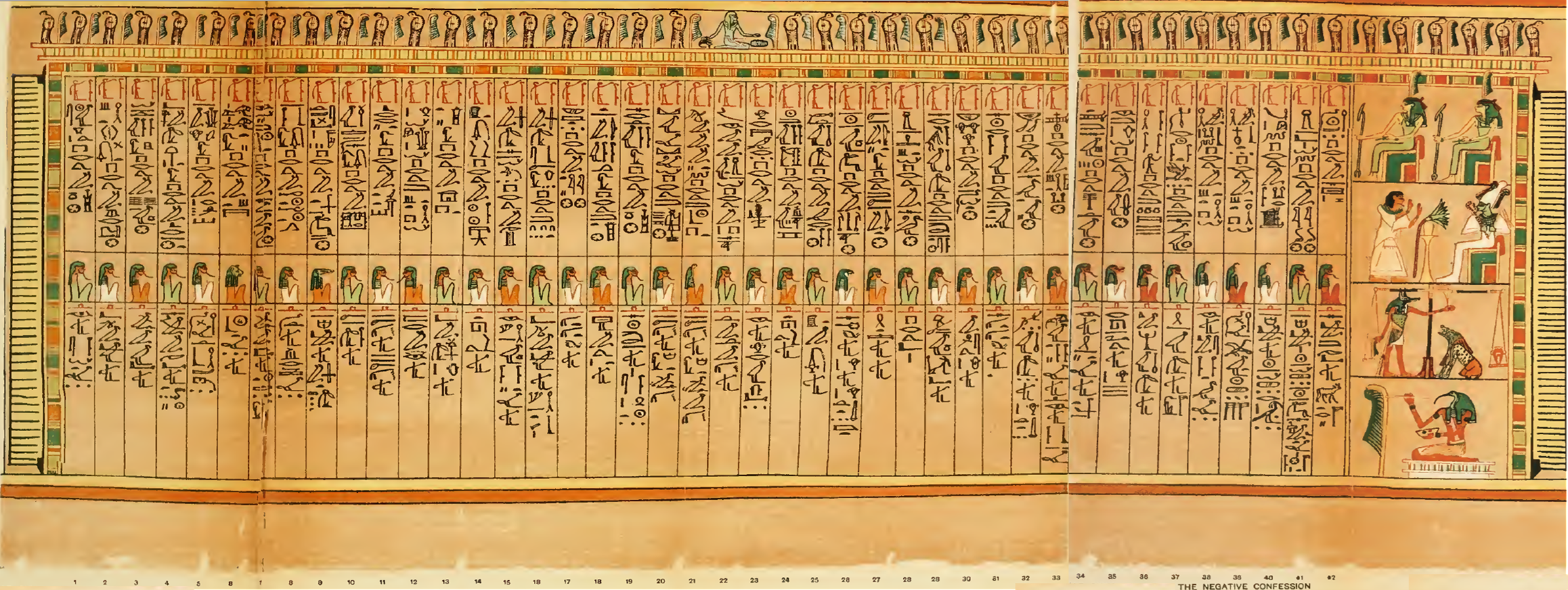
Source: E. A. Wallis Budge (ed.), The Book of the Dead: Facsimile of the Papyrus of Ani in the British Museum, London, 1890, Plates XXXI–XXXII.
The two plates have been combined into a single image representing Chapter 125B — the 42 Negative Confessions.
Original: British Museum, Papyrus of Ani, EA10470,31–32.
Col. 1 / Negative Confession 1
| ¹i ²wsx ³nmtt ⁴pr ⁵m ⁶iwnw ⁷n ⁸iri ⁹.i ¹⁰isft | O Wide-strider, coming forth from Heliopolis, I have not committed wrongdoings. | Ω Πλατυδιασκελιστή, που εξέρχεσαι από την Ηλιούπολη, δεν έχω διαπράξει αδικίες. |
Col. 2 / Negative Confession 2
| ¹i ²Hpt ³Ht ⁴pr ⁵m ⁶xr-aHA ⁷n ⁸awA ⁹.i | O Flame-Embracer, coming forth from Kheraha, I have not robbed. | Ω Αγκαλιαστή της Φλόγας, που εξέρχεσαι από τη Χερ-Άχα, δεν έχω ληστέψει. |
Col. 3 / Negative Confession 3
| ¹i ²fndy ³pr ⁴m ⁵xmnw ⁶n ⁷TAw ⁸.i | O Long-nosed one, coming forth from Hermopolis, I have not stolen. | Ω Μακρόμυτε, που εξέρχεσαι από την Ερμούπολη, δεν έχω κλέψει. |
Col. 4 / Negative Confession 4
| ¹i ²am ³Swyt ⁴pr ⁵m ⁶qrnt ⁷n ⁸smA ⁹.i ¹⁰rmT ¹¹sp-sn | O Devourer of Shadows, coming forth from Qernet, I have not slain people; I have not slain people. | Ω Καταβροχθιστή των Σκιών, που εξέρχεσαι από την Κερνέτ, δεν έχω σκοτώσει ανθρώπους· δεν έχω σκοτώσει ανθρώπους. |
Col. 5 / Negative Confession 5
| ¹i ²nHA ³Hr ⁴pr ⁵m ⁶r-stAw ⁷n ⁸HD ⁹dbHw | O Terrible-faced One, coming forth from the Rostau necropolis, I have not diminished the offerings. | Ω Φρικτέ στην όψη, που εξέρχεσαι από τη νεκρόπολη Ροστάου, δεν έχω μειώσει τις προσφορές. |
Col. 6 / Negative Confession 6
| ¹i ²rwty ³pr ⁴m ⁵pt ⁶n ⁷Hbt ⁸.i | O Two-Lion God, coming forth from heaven, I have not taken anything away (from the offerings). | Ω Θεέ των Δύο Λιονταριών, που εξέρχεσαι από τον ουρανό, δεν έχω αποσπάσει τίποτα (από τις προσφορές). |
Col. 7 / Negative Confession 7
| ¹i ²irty ³.f ⁴m ⁵xt ⁶pr ⁷m ⁸sAwt ⁹n ¹⁰TAw ¹¹.i ¹²xt ¹³nTr | O He whose two eyes are of fire, coming forth from Asyut, I have not stolen the property of the god. | Ω Εσύ που τα μάτια σου είναι φωτιά, που εξέρχεσαι από την Ασιούτ, δεν έχω κλέψει την περιουσία του θεού. |
Col. 8 / Negative Confession 8
| ¹i ²nbi ³pr ⁴m ⁵xtxt ⁶n ⁷Dd ⁸.i ⁹grgw | O Flaming One, coming forth from Khetkhet, I have not spoken lies. | Ω Φλεγόμενε, που εξέρχεσαι από τη Χετχέτ, δεν έχω πει ψέματα. |
Col. 9 / Negative Confession 9
| ¹i ²sD ³qSw ⁴pr ⁵m ⁶nni-nsw ⁷n ⁸nHm ⁹.i ¹⁰wnmt | O Breaker of Bones, coming forth from Herakleopolis, I have not stolen food. | Ω Θραύστη των οστών, που εξέρχεσαι από την Ηρακλεόπολη, δεν έχω κλέψει τροφή. |
Col. 10 / Negative Confession 10
| ¹i ²wDw ³nsr ⁴pr ⁵m ⁶Hwt-kA-ptH ⁷n ⁸kni ⁹.i | O Stoker of the Flame, coming forth from Memphis, I have not complained. | Ω Αναζωπυρωτή της Φλόγας, που εξέρχεσαι από τη Μέμφιδα, δεν έχω βαρυγκομήσει. |
Col. 11 / Negative Confession 11
| ¹i ²qrrty ³pr ⁴m ⁵imntt ⁶n ⁷nk ⁸.i ⁹n ¹⁰nk | O He of the Cavern, coming forth from the West, I have not had intercourse with a person engaged in prostitution. | Ω Εσύ της Σπηλιάς, που εξέρχεσαι από τη Δύση, δεν έχω συνευρεθεί με εκπορνευόμενο άνθρωπο. |
Col. 12 / Negative Confession 12
| ¹i ²Hr ³.f ⁴HA ⁵.f ⁶pr ⁷m ⁸tpHt ⁹.f ¹⁰n ¹¹Τrm ¹².i | O He whose face is behind him, coming forth from his cavern, I have not closed my eyes (to anything blameworthy). | Ω Εσύ που το πρόσωπό σου βρίσκεται πίσω σου, που εξέρχεσαι από τη σπηλιά σου, δεν έχω κλείσει τα μάτια μου (σε οτιδήποτε μεμπτό). |
Col. 13 / Negative Confession 13
| ¹i ²bAsty ³pr ⁴m ⁵kArt ⁶n ⁷am-ib ⁸.i | O He of Bubastis, coming forth from the shrine, I have not been neglectful. | Ω Εσύ της Βούβαστης, που εξέρχεσαι από το ιερό, δεν υπήρξα αμελής. |
Col. 14 / Negative Confession 14
| ¹i ²tA ³rdwy ⁴pr ⁵m ⁶ixxw ⁷n ⁸th ⁹.i | O He of the Burning Feet, coming forth from the twilight, I have not transgressed. | Ω Εσύ με τα φλεγόμενα πόδια, που εξέρχεσαι από το λυκόφως, δεν έχω παρεκτραπεί. |
Col. 15 / Negative Confession 15
| ¹i ²wnm ³snf ⁴pr ⁵m ⁶nmt ⁷n ⁸ir ⁹Hnwwt ¹⁰.i | O Eater of Blood, coming forth from the place of execution, I have not committed perjury. | Ω Καταβροχθιστή του Αίματος, που εξέρχεσαι από τον τόπο της εκτέλεσης, δεν έχω επιορκήσει. |
Col. 16 / Negative Confession 16
| ¹i ²wnm ³bskw ⁴pr ⁵m ⁶mAbt ⁷n ⁸awA ⁹.i ¹⁰Hnb ¹¹t | O Eater of Entrails, coming forth from the Place of Thirty, I have not stolen a share of bread. | Ω Καταβροχθιστή των Σπλάχνων, που εξέρχεσαι από τον Τόπο των Τριάντα, δεν έχω κλέψει μερίδιο ψωμιού. |
Col. 17 / Negative Confession 17
| ¹i ²nb ³mAat ⁴pr ⁵m ⁶mAaty ⁷n ⁸mtmt ⁹.i | O Lord of Maat, coming forth from Maaty, I have not eavesdropped. | Ω Κύριε της Μάατ, που εξέρχεσαι από τη Μάατι, δεν έχω κρυφακούσει. |
Col. 18 / Negative Confession 18
| ¹i ²tnmyw ³pr ⁴m ⁵bAst ⁶n ⁷Sm ⁸.tw ⁹.i | O Wanderer, coming forth from Bubastis, I have not grumbled (giving voice to dissatisfaction). | Ω Περιπλανώμενε, που εξέρχεσαι από τη Βούβαστη, δεν έχω γογγύσει (εκφράζοντας δυσαρέσκεια). |
Col. 19 / Negative Confession 19
| ¹i ²srdyw ³pr ⁴m ⁵iwnw ⁶n ⁷sHwn ⁸.i ⁹is ¹⁰Hr ¹¹Ht | O Builder, coming forth from Heliopolis, I have not contended without cause. | Ω Οικοδόμητή, που εξέρχεσαι από την Ηλιούπολη, δεν έχω αντιπαρατεθεί χωρίς αιτία. |
Col. 20 / Negative Confession 20
| ¹i ²Dw ³Dw ⁴.f ⁵pr ⁶m ⁷andti ⁸n ⁹nk ¹⁰.i ¹¹Hmt ¹²TAy | O Doubly Wicked One, coming forth from Andjety, I have not had intercourse with another man’s wife. | Ω Διπλά Κακέ, που εξέρχεσαι από την Άντζιτι, δεν έχω συνευρεθεί με τη γυναίκα άλλου άνδρα. |
Col. 21 / Negative Confession 21
| ¹i ²wAmnty ³pr ⁴m ⁵Hbt ⁶n ⁷nk ⁸.i ⁹Hmt ¹⁰TAy | O Double Serpent, coming forth from the place of execution, I have not had intercourse with another man’s wife. | Ω Διπλέ Όφι, που εξέρχεσαι από τον τόπο της εκτέλεσης, δεν έχω συνευρεθεί με τη γυναίκα άλλου άνδρα. |
Col. 22 / Negative Confession 22
| ¹i ²mAA ³inwt ⁴.f ⁵pr ⁶m ⁷pr ⁸mnw ⁹n ¹⁰dAdA ¹¹.i | O He who looks at what he has brought, coming forth from the domain of Min, I have not committed fornication. | Ω Εσύ που κοιτάζεις αυτό που έχεις φέρει, που εξέρχεσαι από την επικράτεια του Μιν, δεν έχω διαπράξει πορνεία. |
Col. 23 / Negative Confession 23
| ¹i ²Hry ³wrw ⁴pr ⁵m ⁶imAw ⁷n ⁸ir ⁹.i ¹⁰Hrw | O Chief of the Great Ones, coming forth from Iamu, I have not caused terror. | Ω Αρχηγέ των Μεγάλων, που εξέρχεσαι από την Ιάμου, δεν έχω προκαλέσει τρόμο. |
Col. 24 / Negative Confession 24
| ¹i ²Hmyw ³pr ⁴m ⁵HAsww ⁶n ⁷th ⁸.i | O Demolisher, coming forth from HAsww (Egyptian area), I have not transgressed. | Ω Κατεδαφιστή, που εξέρχεσαι από τη HAsww (αιγυπτιακή περιοχή), δεν έχω παρεκτραπεί. |
Col. 25 / Negative Confession 25
| ¹i ²Sd ³Hrw ⁴pr ⁵m ⁶wryt ⁷n ⁸tA ⁹.i | O Causer of Disorder, coming forth from Urit, I have not flown into a rage. | Ω Προκαλών την Αναστάτωση, που εξέρχεσαι από την Ουρίτ, δεν έχω παραφερθεί από οργή. |
Col. 26 / Negative Confession 26
| ¹i ²nxnw ³pr ⁴m ⁵wAbwy ⁶n ⁷sx ⁸.i ⁹Hr ¹⁰.i ¹¹Hr ¹²mdt ¹³mAat | O Child, coming forth from Wabwy, I have not turned a deaf ear to words of truth. | Ω Παιδί, που εξέρχεσαι από την Ουάμπουι, δεν έχω κωφεύσει στα λόγια της αλήθειας. |
Col. 27 / Negative Confession 27
| ¹i ²knmty ³pr ⁴m ⁵knmt ⁶n ⁷Snt ⁸.i | O Dark One, coming forth from the Darkness, I have not reviled anyone. | Ω Σκοτεινέ, που εξέρχεσαι από το Σκοτάδι, δεν έχω προσβάλει κανέναν. |
Col. 28 / Negative Confession 28
| ¹i ²in ³Htp ⁴.f ⁵pr ⁶m ⁷sAw ⁸n ⁹pr-a | O Bringer of His Offering, coming forth from Sais, I have not acted violently. | Ω Φέροντα την Προσφορά του, που εξέρχεσαι από τη Σάιδα, δεν έχω φερθεί βίαια. |
Col. 29 / Negative Confession 29
| ¹i ²sri ³Hrw ⁴pr ⁵m ⁶wnis ⁷n ⁸Hnnw ⁹.i | O Announcer of the Decision, coming forth from Unis, I have not conspired. | Ω Αναγγελλών την Απόφαση, που εξέρχεσαι από την Ούνις, δεν έχω συνωμοτήσει. |
Col. 30 / Negative Confession 30
| ¹i ²nb ³Hrw ⁴pr ⁵m ⁶nDft ⁷n ⁸As-ib ⁹.i | O Lord of Faces, coming forth from Nedjefet, I have not judged hastily (out of impatience). | Ω Κύριε των Προσώπων, που εξέρχεσαι από τη Ντζεφέτ, δεν έχω κρίνει βιαστικά (από ανυπομονησία). |
Col. 31 / Negative Confession 31
| ¹i ²SHrjw ³pr ⁴m ⁵wtn ⁶n ⁷smtmt ⁸.i | O Accuser, coming forth from Wten, I have not eavesdropped at doors. | Ω Κατήγορε, που εξέρχεσαι από την Ουτέν, δεν έχω κρυφακούσει πίσω από πόρτες. |
Col. 32 / Negative Confession 32
| ¹i ²nb ³abwy ⁴pr ⁵m ⁶sAwty ⁷n ⁸aSA-Hrw ⁹.i ¹⁰Hr ¹¹mdwt | O Lord of the Two Horns, coming forth from Asyut, I have not been excessive in words. | Ω Κύριε των Δύο Κεράτων, που εξέρχεσαι από την Ασιούτ, δεν έχω υπάρξει υπερβολικός στα λόγια μου. |
Col. 33 / Negative Confession 33
| ¹i ²nfr-tm ³pr ⁴m ⁵Hwt-kA-ptH ⁶n ⁷iwyt ⁸.i ⁹n ¹⁰ir ¹¹.i ¹²bin | O Nefertum, coming forth from Memphis, I have not committed wrongdoing; I have not done evil. | Ω Νεφέρτουμ, που εξέρχεσαι από τη Μέμφιδα, δεν έχω διαπράξει παράπτωμα· δεν έχω πράξει κακό. |
Col. 34 / Negative Confession 34
| ¹i ²tm ³spw ⁴pr ⁵[m] ⁶Ddw ⁷n ⁸ir ⁹.i ¹⁰Snti ¹¹nswt | O Remover of Faults, coming forth from Busiris, I have not uttered curses against the king. | Ω Εξαλείφοντα τα Παραπτώματα, που εξέρχεσαι από τη Βούσιρι, δεν έχω εκφέρει κατάρες εναντίον του βασιλιά. |
Col. 35 / Negative Confession 35
| ¹i ²ir ³m ⁴ib ⁵.f ⁶pr ⁷m ⁸Tbw ⁹n ¹⁰rhn ¹¹.i ¹²Hr ¹³mw | O He who acts according to his mind, coming forth from Antaeopolis, I have not drawn hasty conclusions. | Ω Εσύ που ενεργείς σύμφωνα με τον νου σου, που εξέρχεσαι από την Ανταιόπολη, δεν έχω βγάλει βιαστικά συμπεράσματα. |
Col. 36 / Negative Confession 36
| ¹i ²iHy ³pr ⁴m ⁵nwn ⁶n ⁷qA-Hrw ⁸.i | O Ihy, coming forth from Nun, I have not raised my voice (to impose myself). | Ω Ίχι, που εξέρχεσαι από τον Νουν, δεν έχω υψώσει τη φωνή μου (για να επιβληθώ). |
Col. 37 / Negative Confession 37
| ¹i ²wD ³rHyt ⁴pr ⁵m ⁶sAw ⁷n ⁸Sn ⁹.i ¹⁰nTr | O Commander of the Subjects, coming forth from Sais, I have not cursed a god. | Ω Διοικητή των Υπηκόων, που εξέρχεσαι από τη Σάιδα, δεν έχω καταραστεί θεό. |
Col. 38 / Negative Confession 38
| ¹i ²nHb-kAw ³pr ⁴m ⁵tpHt ⁶.f ⁷n ⁸ir ⁹.i ¹⁰sAqywt | O Nehebkau, coming forth from his cavern, I have not caused acts of destruction. | Ω Νεχεμπκάου, που εξέρχεσαι από τη σπηλιά σου, δεν έχω προκαλέσει καταστροφές. |
Col. 39 / Negative Confession 39
| ¹i ²nHb ³nfrwt ⁴pr ⁵m ⁶tpHt ⁷.f ⁸n ⁹HD ¹⁰pAwt ¹¹nTrw | O Bestower of Goodness, coming forth from his cavern, I have not damaged the food offerings of the gods. | Ω Χορηγέ της Αγαθότητας, που εξέρχεσαι από τη σπηλιά σου, δεν έχω βλάψει τις προσφορές τροφής των θεών. |
Col. 40 / Negative Confession 40
| ¹i ²Dsr-tp ³pr ⁴m ⁵kAri ⁶n ⁷nHm ⁸.i ⁹Hnfw ¹⁰r ¹¹Axw | O Upright-Headed Serpent, coming forth from the shrine, I have not taken away cakes from the Spirits. | Ω Όφι με το υψωμένο κεφάλι, που εξέρχεσαι από το ιερό, δεν έχω αφαιρέσει άρτους από τα Πνεύματα. |
Col. 41 / Negative Confession 41
| ¹i ²in ³a ⁴.f ⁵pr ⁶m ⁷mAaty ⁸n ⁹nHm ¹⁰.i ¹¹Hnfw ¹²nHn ¹³n ¹⁴sAt ¹⁵.i ¹⁶nTr ¹⁷niwt | O Serpent who fetches his portion, coming forth from Maaty, I have not taken away the cakes of a child; I have not demeaned a local god. | Ω Όφι που αναζητάς τη μερίδα σου, που εξέρχεσαι από τη Μάατι, δεν έχω αφαιρέσει τους άρτους ενός παιδιού· δεν έχω υποτιμήσει έναν τοπικό θεό. |
Col. 42 / Negative Confession 42
| ¹i ²HD ³ibHw ⁴pr ⁵m ⁶tA-S ⁷n ⁸smA ⁹.i ¹⁰kA ¹¹nTry | O White-Toothed One, coming forth from the Fayoum, I have not slain the divine Bull. | Ω Εσύ με τα Λευκά Δόντια, που εξέρχεσαι από το Φαγιούμ, δεν έχω σκοτώσει τον θεϊκό Ταύρο. |
Chapter 175 — Not Dying a Second Time
Plate XXIX (Cols. 1-19)
Notice: For Chapter 175, we focus only on the passage spanning the end of Column 17 and the beginning of Column 18, concerning the destruction of creation and the return of the earth to Nun, in its original watery state.
| ¹iw.i ²grt ³r ⁴HD ⁵irt.n.i ⁶nbt ⁷iw ⁸tA ⁹pn ¹⁰r ¹¹ii ¹²m ¹³nwn | I (Atum), indeed, will destroy everything that I created, and this land will return (through a flood of waters) to Nun — the primordial waters — returning to the state in which it existed before creation. | Εγώ (ο Άτουμ), πράγματι, θα καταστρέψω όλα όσα δημιούργησα, και αυτή η γη θα επιστρέψει (μέσω κατακλυσμού υδάτων) στο Νουν — στα αρχέγονα ύδατα — επιστρέφοντας στην κατάσταση στην οποία βρισκόταν πριν από τη δημιουργία. |

Source: E. A. Wallis Budge, The Book of the Dead: The Papyrus of Ani in the British Museum, Vol. II, London, 1913, pp. 563–564.
Detail: Plate XXIX, Chapter 175, Col. 17. Image cropped to show the passage concerning the destruction of creation and the return to the primordial waters.
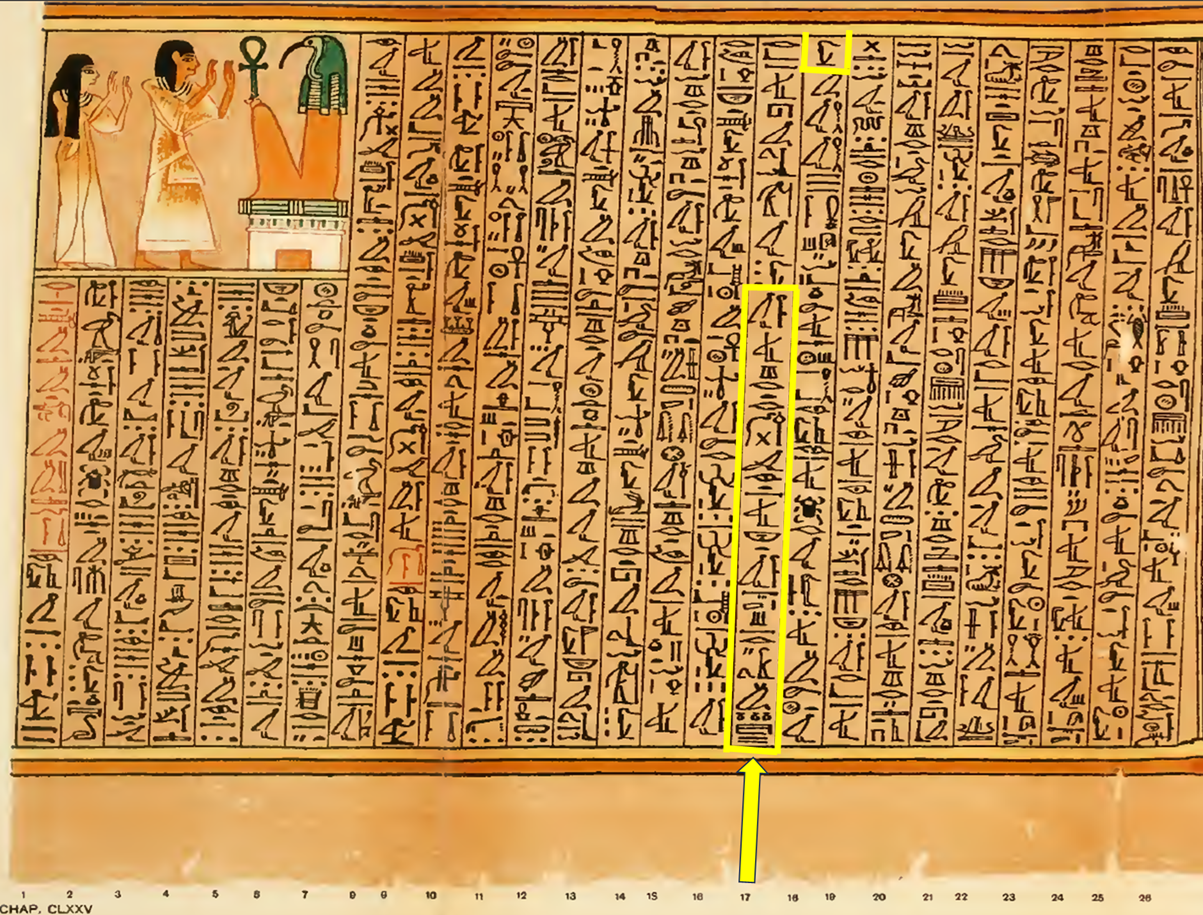
Source: E. A. Wallis Budge (ed.), The Book of the Dead: Facsimile of the Papyrus of Ani in the British Museum, London, 1890, Plate XXIX.
The relevant section of Plate XXIX has been isolated to present the complete Chapter 175 — Not Dying a Second Time.
Original: British Museum, Papyrus of Ani, EA10470,29.
Later Parallels
1. The 42 Negative Confessions and the Ten Commandments
There is no reason to expect a one-to-one correspondence between the 42 Negative Confessions and the Ten Commandments, because the Ten Commandments are not ten universal moral rules of the same category.
The prohibition against other gods does not concern human morality; and the concept of the One God already exists explicitly in Egypt, with Aten as a characteristic example. The prohibition of idols is a cultic prohibition. The Sabbath is a specific command concerning the observance of a particular day.
Nor is “honor your father and your mother” universal and unconditional. The Gospel itself sets its limit:
Matthew 10:35: “For I came to set a man against his father, and a daughter against her mother.”
Therefore, it is not strange that such specific religious or relational commandments are absent from the 42 Negative Confessions.
What is already present in the Papyrus of Ani, however, are exactly the four fundamental prohibitions that, centuries later, the Word of God himself lists first when asked which commandments must be observed in order to enter into life:
- Papyrus of Ani, Col. 4: “I have not killed people.”
- → Later became: “You shall not murder.”
- Papyrus of Ani, Cols. 20–21: “I have not had intercourse with another man’s wife.”
- → Later became: “You shall not commit adultery.”
- Papyrus of Ani, Cols. 2, 3, 7, 9, 16, 40, etc.: robbery, theft, and the taking of another person’s goods, food, or offerings.
- → Later became: “You shall not steal.”
- Papyrus of Ani, Col. 8: “I have not told lies.” and Col. 15: “I have not sworn falsely.”
- → Later became: “You shall not bear false witness.”
And in Matthew 19:18–19, when the Word of God is asked directly “Which ones?”, he answers:
“You shall not murder, you shall not commit adultery, you shall not steal, you shall not bear false witness…”
That is, the first four commandments he himself names are exactly the four universal moral prohibitions already recorded, centuries earlier, in the 42 Negative Confessions of the Papyrus of Ani.
2. Floods
In the Papyrus of Ani, Atum declares:
“I will destroy everything that I have created; and this land will return to Nun.”
The pattern is clear:
creation → destruction → return of the world to the primordial waters.
And the Papyrus of Ani is not even the earliest surviving record of this pattern.
Before the later Greek and biblical narratives, we already have four real, surviving records from Egypt and Mesopotamia:
- Egypt — Coffin Texts, Spell 1130: the “Great Flood.”
- Egypt — Papyrus of Ani, Chapter 175: destruction of creation and return of the land to Nun.
- Babylonia — Atrahasis: a flood intended to destroy humanity and the rescue of the chosen survivor by boat.
- Babylonia — Gilgamesh, Tablet XI: flood, boat, and the survival of Utnapishtim.
And later appear:
- the Flood of Ogyges
- the Flood of Deucalion
- the Flood of Dardanus
- the Flood of Noah
Four earlier records. Four later traditions.
And while the number by itself does not constitute proof, the historical sequence is established, and no theory unsupported by corresponding evidence can overturn who possessed the earlier knowledge.
Proclus, in Commentary on Plato’s Timaeus, Book IV, states clearly that the Egyptians and, long before them, the Chaldeans had already made the relevant observations concerning celestial phenomena long before the later Greeks:
«καὶ Αἰγύπτιοι πρὸ αὐτῶν τηρήσεσι χρησάμενοι καὶ ἔτι πολλῷ πρότερον Χαλδαῖοι…»
And this is not written by a Christian author attempting to diminish the Greek tradition. It is written by Proclus, one of the last great representatives of the Greek philosophical tradition and Head of Plato’s Academy.
The sequence, therefore, is stated by the Head of Plato’s Academy himself: the knowledge already existed in Egypt and Chaldea. Much later, it appears in the Greek oral tradition.
The evidence proves this sequence:
Egyptian coffins exist.
Babylonian tablets exist.
The Papyrus of Ani exists.
And all of them precede the later Greek and biblical records that are presented today as the familiar stories of the Flood.
There is no need to turn a deaf ear to words of truth simply because the historical sequence is not the one we were taught.
What do we learn from the 42 Negative Confessions?
The 42 Negative Confessions demonstrate with certainty that an extensive system of moral rules had already been recorded in Egypt centuries before the Ten Commandments and the Gospels.
And these rules are not merely older. They are defined in more universal terms and cover a far broader range of human conduct.
The individual declares that:
- he has not killed,
- he has not stolen,
- he has not spoken lies,
- he has not committed perjury,
- he has not taken food or offerings,
- he has not had intercourse with another man’s wife,
- he has not caused fear,
- he has not used violence,
- he has not mistreated others,
- he has not eavesdropped,
- he has not spoken excessively,
- he has not judged hastily,
- he has not raised his voice in order to impose himself,
- he has not caused destruction,
- and, in Col. 26, “he has not turned a deaf ear to words of truth.”
This last statement acquires particular significance when, many centuries later, we hear from the Word of God:
«πᾶς ὁ ὢν ἐκ τῆς ἀληθείας ἀκούει μου τῆς φωνῆς.»
— John 18:37
I have not turned a deaf ear to words of truth → everyone who is of the truth hears my voice.
The continuity of meaning is direct.
And there is something even more fundamental.
The 42 Negative Confessions do not say “I believed.” They speak of what the individual did and did not do.
What matters is how the individual lived: whether he killed, stole, lied, committed injustice, used violence, exploited others or closed his ears to the truth.
The measure is not a profession of belief. The measure is the way a human being lives.
And exactly the same criterion reappears later in the Gospels: invoking God is not enough; what carries weight is what one does.
And what would someone learn if they read the entire Papyrus of Ani?
The first and most obvious conclusion is social.
People who truly live according to these rules create a society of human beings.
And this is not our own retrospective idealization of Egypt.
Isocrates, in the Busiris, after describing the organization, laws and way of life of the Egyptians, goes so far as to contrast Egyptian society directly with Spartan society and to write that the Egyptians live as human beings ought to live: they attend to their own affairs and do not covet the property of others.
In other words, centuries later, a Greek author describes in practice precisely the social result one would expect from the moral rules we read in the Negative Confessions.
But the Papyrus of Ani is not limited to social morality.
If someone read the Papyrus of Ani without first being told what they were “supposed” to see in a supposedly strange “Book of the Dead,” they would encounter a complete system of thought concerning:
the human being, morality, truth, deeds, creation and humanity’s place within it.
They would see something much simpler and more fundamental: how a human being should live so that human life may truly be human. And if people lived according to these moral rules — without murder, theft, falsehood, violence, exploitation or turning a deaf ear to truth — the natural result would be societies like the one Isocrates admired and described centuries later: societies in which human beings lived as human beings ought to live.
And then many of the ideas that appear centuries later as familiar Greek, biblical and Christian ideas cease to appear as though they suddenly emerged into history.
They already existed long before.
And they had been recorded.
Hieroglyphs with transliteration
Papyrus of Ani – Hieroglyph and Transliteration 1 – Claude Carrier, Série des papyrus du Livre des morts de l’Égypte ancienne, Tome II: Le Papyrus d’Any (BM EA 10470), Paris, Éditions Cybèle, 2010.
Papyrus of Ani – Hieroglyph and Transliteration 2 – Orlando Mezzabotta, Papyrus of Ani, Plate 31 (Chapter 125B): The Negative Confession (via Free Association Technique), Academia.edu, n.d.
Papyrus of Ani – Hieroglyph and Transliteration 3 – E. A. Wallis Budge — The Papyrus of Ani, 1913 — Vol. I: Facsimile Plates.
Papyrus of Ani – Hieroglyph and Transliteration 4 – E. A. Wallis Budge — The Papyrus of Ani, 1913 — Vol. II: Hieroglyphic Transcript, Translation and Notes.