The Hymn to the Aton (1350 π.Χ.)
Source archive.org/Pritchard1950ANET_201608 / archive.org/Pritchard_1950_ANET.pdf
see also zodml.org/William_Kelley_Simpson_Robert_K_Ritner.pdf
The Pharaoh Amen-hotep IV broke with the established religion of Egypt and instituted the worship of the Aton, the sun disc as the source of life. “The Amarna Revolution” attempted a distinct break with Egypt’s traditional and static ways of life in religion, politics, art, and literature. Pharaoh changed his name to Akh-en-Aton (perhaps “He Who Is Serviceable to the Aton”) and moved his capital from Thebes to Tell el-Amarna. Pharaoh’s own attitude to the god is expressed in the famous hymn which follows. Beyond doubt, the hymn shows the universality and beneficence of the creating and re-creating sun disc. A similarity of spirit and wording to the 104th Psalm has often been noted, and a direct relation between the two has been argued. 1 Because Akh-en-Aton was devoted to this god alone, the Amarna religion has been called monotheistic. This is a debatable question, and a reserved attitude would note that only Akh-en-Aton and his family worshiped the Aton, Akh-en-Aton’s courtiers worshiped Akh-en-Aton himself, and the great majority of Egyptians was ignorant of or hostile to the new faith.
This is the “long hymn” to the Aton, from the tomb of Eye at Tell el-Amarna. Akh-en-Aton’s reign was about 1380 to 1362 B.C. The best copy of the text is that of N. de G. Davies, The Roci^ Tombs of El Amarna, vi (London, 1908), PI. xxvu. Translations will be found in Erman, LAE, 288-91, and in J. H. Breasted, The Dawn of Conscience (New York, 1933), 281-86 *
Praise of Re Har-akhti, Rejoicing on the Horizon, in His Name as Shu Who Is in the Aton-disc, 2 living forever and ever; the living great Aton who is in jubilee, lord of all that the Aton encircles, lord of heaven, lord of earth, lord of the House of Aton in Akhet-Aton; 3 (and praise of) the King of Upper and
Lower Egypt, who lives on truth, the Lord of the Two Lands: Nefer-kheperu-Re Wa-en-Re; the Son of Re, who lives on truth, the Lord of Diadems: Akh-en-Aton, long in his lifetime; (and praise of) the Chief Wife of the King, his beloved, the Lady of the Two Lands: Nefer-neferu-Aton Nefert-iti, living, healthy, and youthful forever and ever; (by) the Fan-Bearer on the Right Hand of the King… Eye. He says:
part 1 – lines 1 to 10
| xay.k nfr m Axt nt pt | You appear beautifully on the horizon of heaven, | Εμφανίζεσαι όμορφα στον ορίζοντα του ουρανού, |
| itn anx SAa anx | Living Aten, beginning of life! | Ζωντανέ Ατέν, αρχή της ζωής! |
| iw.k wbn.ti m Axt | You have risen on the horizon, | Έχεις ανατείλει στον ορίζοντα, |
| mH.n.k tA nb m nfrw.k | you have filled every land with your beauty. | έχεις γεμίσει κάθε χώρα με την ομορφιά σου. |
| iw.k an.ti wr.ti THn.ti qA.ti Hr-tp tA nb | You are beautiful, great, radiant, high above every land. | Είσαι όμορφος, μέγας, λαμπρός, ψηλά πάνω από κάθε χώρα. |
| stwt.k inH.sn tAw r r-a irt.n.k nb | Your rays encompass the lands to the limit of all that you have made. | Οι ακτίνες σου περιβάλλουν τις χώρες μέχρι τα όρια όλων όσων έχεις δημιουργήσει. |
| iw.k m ra in.k r r-a.sn | As Re, you reach their limits. | Ως Ρα, φτάνεις μέχρι τα όριά τους. |
| waf.k sn (n) sA-mr.k | You subdue them for your beloved son. | Τους υποτάσσεις για χάρη του αγαπημένου σου γιου. |
| iw.k wA.ti stwt.k Hr tA | Though you are distant, your rays are on earth, | Παρότι είσαι μακριά, οι ακτίνες σου βρίσκονται στη γη, |
| tw.k m Hr.sn nw Smw.k | though you are before their faces, no one knows your going. | παρότι βρίσκεσαι μπροστά στα πρόσωπά τους, κανείς δεν γνωρίζει την πορεία σου. |
part 2 – lines 11 to 22
| Htp.k m Axt imntt tA m kk m sxr n mwt | When you set in the western horizon, the land is in darkness, in the manner of death. | Όταν δύεις στον δυτικό ορίζοντα, η γη βρίσκεται στο σκοτάδι, σαν σε κατάσταση θανάτου. |
| sDrw m Ssp tpw Hbs | People sleep in chambers, their heads covered, | Οι άνθρωποι κοιμούνται στους θαλάμους, με τα κεφάλια τους καλυμμένα, |
| n ptr.n irt snwt.s | no eye sees another. | κανένα μάτι δεν βλέπει το άλλο. |
| iTA.tw xt.sn nb iw.w Xr tp.sn n am.sn | All their possessions under their heads might be stolen, and they would not know it. | Όλα τα υπάρχοντά τους που βρίσκονται κάτω από τα κεφάλια τους θα μπορούσαν να κλαπούν, και εκείνοι δεν θα το αντιλαμβάνονταν. |
| mAi nb pr m rwty.f | Every lion comes forth from its den, | Κάθε λιοντάρι βγαίνει από τη φωλιά του, |
| Ddft nb psH.sn | every snake bites. | κάθε φίδι δαγκώνει. |
| kkw HAw tA m sgr pA ir.sn Htp m Axt.f | Darkness envelops the land in silence, for their creator rests in his horizon. | Το σκοτάδι περιβάλλει τη γη μέσα στη σιωπή, γιατί ο δημιουργός τους αναπαύεται στον ορίζοντά του. |
| HD-tA wbn.ti m Axt psd.ti m itn m h(rw) | At daybreak, when you rise on the horizon, shining as the Aten by day, | Με το ξημέρωμα, όταν ανατέλλεις στον ορίζοντα, λάμποντας ως Ατέν την ημέρα, |
| rwi.k kkw di.k stwt.k | you drive away the darkness and give your rays. | διώχνεις το σκοτάδι και χαρίζεις τις ακτίνες σου. |
| tAwy m Hb rs aHa Hr rdwy | The Two Lands are in festival, awake and standing on their feet, | Οι Δύο Χώρες γιορτάζουν, ξύπνιες και όρθιες στα πόδια τους, |
| Tsy.n.k sn wab Haw.sn Sspw wnxw | for you have raised them up; their bodies cleansed, their clothing on, | γιατί εσύ τις έχεις σηκώσει· τα σώματά τους καθαρισμένα, τα ρούχα τους φορεμένα, |
| awy.sn m iAw n xaa.k | their arms raised in adoration at your appearance. | τα χέρια τους υψωμένα σε λατρεία κατά την εμφάνισή σου. |
part 3 – lines 23 to 34
| tA r-Dr.f ir.sn kAt.sn | The entire land carries out its work, | Ολόκληρη η χώρα εκτελεί τις εργασίες της, |
| iAt nb Htp Hr smw.sn | every herd rests in its pasture, | κάθε κοπάδι αναπαύεται στο βοσκοτόπι του, |
| Snw smw Hr AxAxw | trees and plants are flourishing, | τα δέντρα και τα φυτά ευδοκιμούν, |
| Apdw pAw m Ssw.sn | birds fly from their nests, | τα πουλιά πετούν από τις φωλιές τους, |
| dnHw.sn m iAw n kA.k | their wings in adoration of your ka. | τα φτερά τους σε λατρεία προς το κα σου. |
| awt nb Hr Tbhn Hr rdwy | Every herd frolics on its feet. | Κάθε κοπάδι σκιρτά στα πόδια του. |
| pAyw xnnt nb | Everything that flies and alights, | Ό,τι πετά και προσγειώνεται, |
| anx.sn wbn n.k sn | lives when you rise for them. | ζει όταν ανατέλλεις γι’ αυτό. |
| aHaw m xd xnty m-mitt | Ships sail downstream and upstream alike, | Τα πλοία πλέουν προς τα κάτω και προς τα πάνω στο ρεύμα εξίσου, |
| wAt nb wn n xa.k | every road is open at your appearance. | κάθε δρόμος ανοίγει με την εμφάνισή σου. |
| rmw Hr itrw Hr tft n Hr.k | The fish in the river dart before your face. | Τα ψάρια στον ποταμό τινάζονται μπροστά στο πρόσωπό σου. |
| stwt.k m-Xn wAD-wr | Your rays are in the midst of the Celestial Ocean. | Οι ακτίνες σου βρίσκονται μέσα στον Ουράνιο Ωκεανό. |
part 4 – lines 35 to 47
| sxpr mAyw m Hmwt | You cause seed to develop in women, | Κάνεις το σπέρμα να αναπτύσσεται στις γυναίκες, |
| ir mw m rmT | you transform seminal fluid into human beings, | μετατρέπεις το σπερματικό υγρό σε ανθρώπους, |
| sanx sA m Xt n mwt.f | you cause the son to live in his mother’s womb, | κάνεις τον γιο να ζει στη μήτρα της μητέρας του, |
| sgrH sw m tmt rmy.f | you soothe him so that he ceases to cry. | τον ηρεμείς ώστε να πάψει να κλαίει. |
| mnat m Xt dyw TAw r sanx irt.f nb | Nurse in the womb, giver of breath to sustain all that he has made, | Τροφέ μέσα στη μήτρα, που δίνεις πνοή για να κρατήσεις στη ζωή όλα όσα έχει δημιουργήσει, |
| hA.f m Xt r tpt hrw msw.f | when he comes from the womb to breathe on the day of his birth, | όταν βγαίνει από τη μήτρα για να αναπνεύσει την ημέρα της γέννησής του, |
| wpw.k r.f Hr qd | you open his mouth completely, | ανοίγεις εντελώς το στόμα του, |
| ir.k xrt.f | you provide for his needs. | φροντίζεις για τις ανάγκες του. |
| iw TA m swHt mdw m inr | When the chick in the egg speaks within the shell, | Όταν ο νεοσσός μέσα στο αυγό μιλά μέσα από το κέλυφος, |
| di.k n.f TAw m-Xnw.s r sanx.f | you give him breath within it to sustain him. | του δίνεις πνοή μέσα σε αυτό για να τον κρατήσεις στη ζωή. |
| ir.n.k n.f dmdy.f r sd.s m swHt | You have brought him to maturity within the egg so that he may break it, | Τον έχεις οδηγήσει στην ωριμότητα μέσα στο αυγό, ώστε να μπορέσει να το σπάσει, |
| pr.f m swHt r mdt r dmdy.f | he comes forth from the egg to speak at his maturity, | βγαίνει από το αυγό για να μιλήσει όταν έχει ωριμάσει, |
| Sm.f Hr rdwy.fy pr.f im.s | and walks on his legs when he comes forth from it. | και περπατά στα πόδια του μόλις βγει από αυτό. |
part 5 – lines 48 to 58
| aSA.wy siry.k iw.w StAw m Hr | How numerous are your works, though they are hidden from sight! | Πόσο πολλά είναι τα έργα σου, αν και είναι κρυμμένα από το βλέμμα! |
| pA nTr wa nn ky Hr-xw.f | The sole god, there is no other beside him. | Ο μοναδικός θεός· δεν υπάρχει άλλος δίπλα του. |
| qmA.k tA n ib.k iw.k wa.ti | You created the earth as your heart desired, while you were alone, | Δημιούργησες τη γη όπως επιθυμούσε η καρδιά σου, ενώ ήσουν μόνος, |
| m rmT mnmnt awt nb | with people, herds, and every flock, | με ανθρώπους, αγέλες και κάθε κοπάδι, |
| nty Hr tASm.w Hr rdwy | all that are on earth, walking on their feet, | όλα όσα βρίσκονται στη γη και περπατούν στα πόδια τους, |
| nty m ax Hr pAyw m dnHw.sn | all that are on high, flying with their wings, | όλα όσα βρίσκονται ψηλά και πετούν με τα φτερά τους, |
| xAswt xAr kS pA tA n kmt | the foreign lands of Khar and Kush, and the land of Egypt. | τις ξένες χώρες του Χαρ και του Κους, και τη χώρα της Αιγύπτου. |
| di.k s nb r st.f | You set every person in his place, | Τοποθετείς κάθε άνθρωπο στη θέση του, |
| ir.k Xrt.sn | you provide for their needs, | φροντίζεις για τις ανάγκες τους, |
| wa nb Xry r wnmw.f Hsb aHa.f | each one has his food; his lifetime is counted. | ο καθένας έχει την τροφή του· η διάρκεια της ζωής του είναι μετρημένη. |
| nsw wpw m mdwt qdw.sn m mitt | Their tongues differ in speech, and their natures likewise. | Οι γλώσσες τους διαφέρουν στην ομιλία, και οι φύσεις τους επίσης. |
| inmw.sn stnw stn.k xAswt | Their skins are distinct, as you distinguish the foreign peoples. | Τα δέρματά τους είναι διαφορετικά, όπως διακρίνεις τους ξένους λαούς. |
part 6 – lines 59 to 73
| ir.k Hapy m dwAt in.k sw r mr.k | You make Hapy (the Nile Flood) in the Duat; you bring him forth as you desire, | Δημιουργείς τον Χάπι (τον Κατακλυσμό του Νείλου) στη Ντουάτ· τον φέρνεις όπως επιθυμείς, |
| r sanx rxyt mi ir.k sn n.k | to sustain the people, as you made them for yourself, | για να διατηρείς τον λαό στη ζωή, όπως τον δημιούργησες για τον εαυτό σου, |
| nb iry.sn r-Aw im.sn | Lord of them all, who toils for them, | Κύριε όλων τους, που κοπιάζεις γι’ αυτούς, |
| pA nb n tA nb wbn n.sn pA itn n hrw aA Sft | Lord of every land, who rises for them, Aten of the day, great in majesty. | Κύριε κάθε χώρας, που ανατέλλεις γι’ αυτούς, Ατέν της ημέρας, μέγα σε μεγαλείο. |
| xAst nb wAt ir.k anx.sn | You make every distant foreign land live. | Κάνεις κάθε μακρινή ξένη χώρα να ζει. |
| di.n.k Hapy m pt hAy.f n.sn | You have placed Hapy (the Heavenly Flood) in the sky, that he may descend for them, | Έχεις τοποθετήσει τον Χάπι (τον Ουράνιο Κατακλυσμό) στον ουρανό, ώστε να κατεβαίνει γι’ αυτούς, |
| ir.f hnw Hr Dww mi wAD-wr | he makes waves upon the mountains like the Celestial Ocean, | δημιουργεί κύματα πάνω στα βουνά σαν τον Ουράνιο Ωκεανό, |
| r txb AHwt.sn m dmi.sn | to water their fields in their settlements. | για να ποτίζει τα χωράφια τους στους οικισμούς τους. |
| smnx.wy sy sxrw.k pA nb HH | How effective are your plans, O Lord of eternity! | Πόσο αποτελεσματικά είναι τα σχέδιά σου, ω Κύριε της αιωνιότητας! |
| Hapy m pt sw n xAstyw n awt xAst nb Smw rdwy | Hapy (the Heavenly Flood) in the sky is for the foreign peoples and for the animals of every foreign land that walk on their feet; | Ο Χάπι (ο Ουράνιος Κατακλυσμός) στον ουρανό είναι για τους ξένους λαούς και για τα ζώα κάθε ξένης χώρας που περπατούν στα πόδια τους· |
| Hapy iy.f m dwAt n tA mri | Hapy (the Nile Flood) comes from the Duat for the Beloved Land (Egypt). | Ο Χάπι (ο Κατακλυσμός του Νείλου) έρχεται από τη Ντουάτ για την Αγαπημένη Χώρα (Αίγυπτο). |
| stwt.k Hr mna SA nb | Your rays nurse every field; | Οι ακτίνες σου θρέφουν κάθε αγρό· |
| wbn.k anx.sn rwd.sn n.k | when you rise, they live and grow strong for you. | όταν ανατέλλεις, ζουν και δυναμώνουν για σένα. |
| ir.k trw r sxpr iry.k nb | You make the seasons to foster all that you have made, | Δημιουργείς τις εποχές για να ανατρέφουν όλα όσα έχεις δημιουργήσει, |
| prt r sqb.sn hh dp.f st tw | winter to cool them, and heat so that they may taste you. | τον χειμώνα για να τους δροσίζει, και τη ζέστη ώστε να σε γεύονται. |
part 7 – lines 74 to 81
| ir.n.k pt wA.ti r wbn im.s | You made the distant sky in order to rise in it, | Δημιούργησες τον μακρινό ουρανό για να ανατέλλεις μέσα του, |
| r mA iry.k nb iw.k wa.ti wbn.ti m xprw.k m itn anx | to see all that you have made, while you are alone, shining in your form as the Living Aten, | για να βλέπεις όλα όσα έχεις δημιουργήσει, ενώ είσαι μόνος, λάμποντας στη μορφή σου ως Ζωντανός Ατέν, |
| xa.ti psd.ti wA.ti Xn.ti | appearing, radiant, distant yet near. | εμφανιζόμενος, λαμπρός, μακρινός κι όμως κοντινός. |
| ir.k HHw n xprw im.k way | You make millions of forms from yourself alone: | Δημιουργείς εκατομμύρια μορφές από τον εαυτό σου και μόνο: |
| niwt dmiw AHt mtn itrw | cities, towns, fields, roads, and rivers. | πόλεις, οικισμούς, αγρούς, δρόμους και ποταμούς. |
| gmH tw irt nb r aqy.sn | Every eye beholds you before it, | Κάθε μάτι σε βλέπει μπροστά του, |
| iw.k m itn n hrw Hr tp n Sm.n.k | for you are the Aten of the day above the earth. When you have gone, | γιατί είσαι ο Ατέν της ημέρας πάνω από τη γη. Όταν έχεις φύγει, |
| n wnn irt nb qmA.k Hr st r tm.k mA Haw […] wa irt.n.k | no eye remains, whose sight you created […] | κανένα μάτι δεν απομένει, του οποίου την όραση δημιούργησες […] |
part 8 – lines 82 to 102
| iw.k m ib.i nn wn ky rx.tw | You are in my heart; there is no other who knows you, | Είσαι μέσα στην καρδιά μου· δεν υπάρχει άλλος που να σε γνωρίζει, |
| wp Hr sA.k nfr-xprw-ra wa-n-ra | except your son, Neferkheperura-Waenra. | εκτός από τον γιο σου, Νεφερχεπερουρά-Ουαενρά. |
| di.k sSA.f m sxrw.k m pHty.k | You make him knowledgeable of your plans and your power. | Τον κάνεις γνώστη των σχεδίων σου και της δύναμής σου. * |
| xpr tA Hr a.k | The land comes into being by your hand, | Η γη έρχεται σε ύπαρξη από το χέρι σου, |
| mi ir.k sn | just as you made them. | όπως τους δημιούργησες. |
| wbn.n.k anx.sn | When you rise, they live; | Όταν ανατέλλεις, ζουν· |
| Htp.k mwt.sn | when you set, they die. | όταν δύεις, πεθαίνουν. |
| ntk aHa r Haw.k | You are lifetime itself; | Εσύ είσαι η ίδια η διάρκεια της ζωής· |
| anx.tw im.k | one lives through you. | μέσω εσένα ζει κανείς. |
| wn irw Hr nfrw.k r Htp.k | Eyes remain fixed on your beauty until you set. | Τα μάτια μένουν στραμμένα στην ομορφιά σου μέχρι να δύσεις. |
| wAH.tw kAt nb | All work is laid aside | Κάθε εργασία σταματά |
| Htp.k Hr imny | when you set in the west. | όταν δύεις στη Δύση. |
| wbn srwd […] nswt | When you rise, you make […] flourish for the king. | Όταν ανατέλλεις, κάνεις […] να ευημερεί για τον βασιλιά. |
| wn m rd nb Dr snT.k tA | Movement is in every leg since you founded the earth. | Κίνηση υπάρχει σε κάθε πόδι από τότε που θεμελίωσες τη γη. |
| wTs.k sn n sA.k pr m Haw.k | You raise them up for your son who came forth from your body, | Τους σηκώνεις για τον γιο σου, που προήλθε από το σώμα σου, |
| nswt anx m mAat nb tAwy | the King who lives in Maat, Lord of the Two Lands, | τον Βασιλιά που ζει στη Μαάτ, Κύριο των Δύο Χωρών, |
| nfr-xprw-ra wa-n-ra | Neferkheperura-Waenra, | Νεφερχεπερουρά-Ουαενρά, |
| sA ra anx m mAat nb xaw | Son of Ra, who lives in Maat, Lord of Risings, | Υιό του Ρα, που ζει στη Μαάτ, Κύριο των Ανατολών, |
| ax-n-itn wr m aHa.f | Akhenaten, great in his lifetime, | Ακενατών, μέγα στη διάρκεια της ζωής του, |
| Hmt nswt wrt mrt.f nbt tAwy | and the Great King’s Wife, his beloved, Lady of the Two Lands, | και τη Μεγάλη Βασιλική Σύζυγο, την αγαπημένη του, Κυρία των Δύο Χωρών, |
| nfr-nfrw-itn nfrt-ii.ti anx.ti Dt | Neferneferuaten Nefertiti, living forever. | Νεφερνεφερουατέν Νεφερτίτι, ζωντανή για πάντα. |
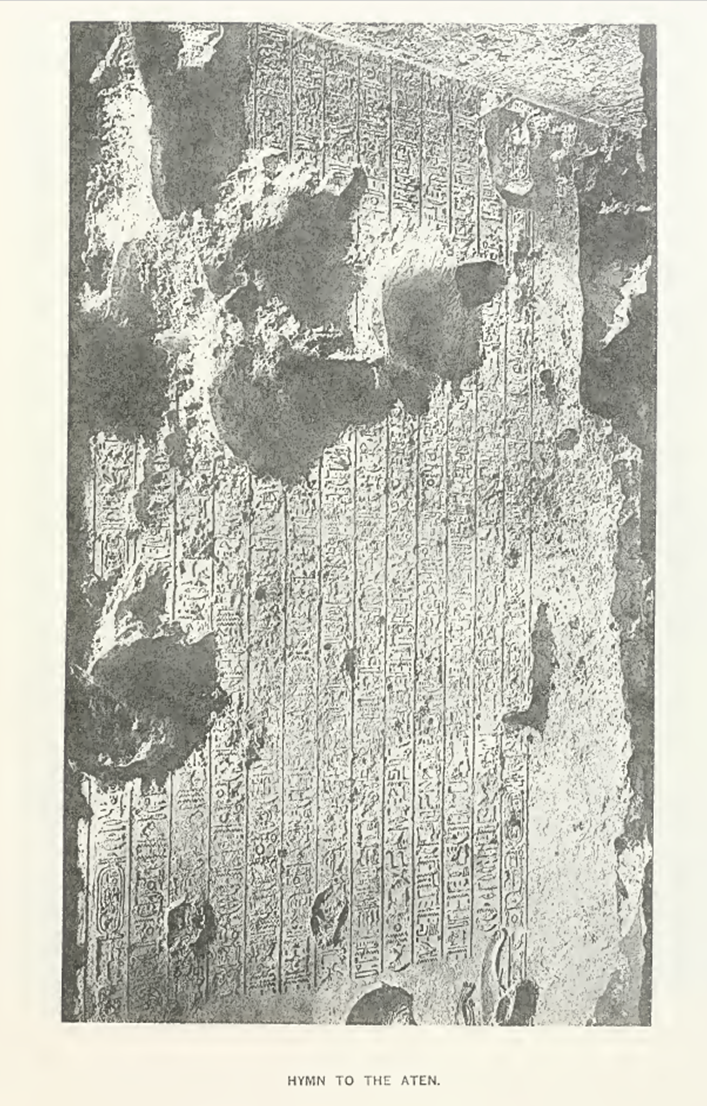
plate XLI (p.145) from N. de G. Davies The Rock Tombs of el Amarna (London, 1908)
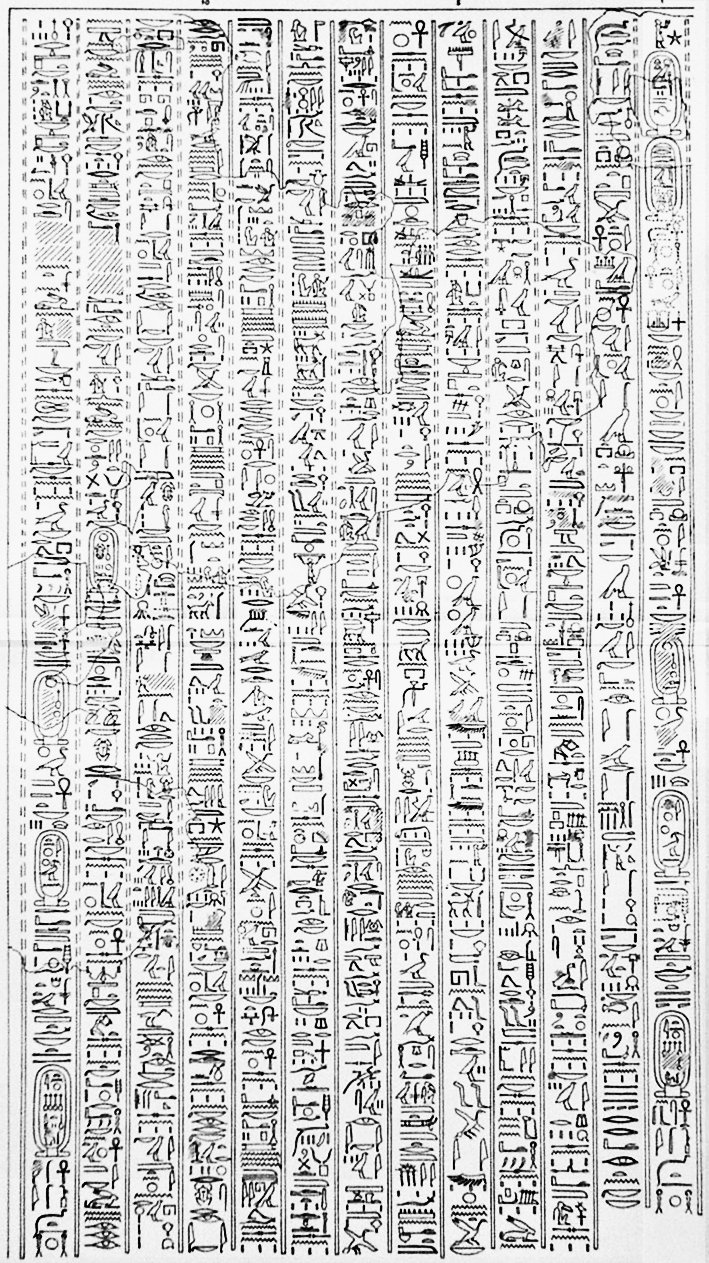
photo en.wikipedia.org/wiki/
* From the context, this continues the idea of Amon as a soothing breeze against more violent winds.
1 As in Breasted, op. cit., 366-70.
2 The Aton had a dogmatic name written within a royal cartouche and including the three old solar deities, Re, Har-of-the-Horizon, and Shu.
3 Akhet-Aton was the name of the capital at Tell el-Amarna.
Note
* Pharaoh was the official intermediary between the Egyptians and their gods. The Amarna religion did not change this dogma.
What do we learn from The Hymn to the Aten?
The Great Hymn to the Aten, inscribed in thirteen columns of hieroglyphic text in the tomb of Ay at Amarna and dating to the reign of Akhenaten, approximately the middle of the 14th century BCE, already presents a remarkably developed and coherent theological, cosmological, and anthropological system.
And the chronology matters. What we are examining is a primary Egyptian document from the 14th century BCE — well over a millennium earlier than the earliest surviving biblical manuscript witnesses that we have so far identified and examined.
Aten is explicitly presented as “the sole god; there is no other beside him.” And this uniqueness does not belong to a local deity confined to Egypt. He is the creator of the earth, of human beings, animals and plants, of Egypt, but also of foreign lands and peoples.
The text therefore already combines:
one sole god → one universal Creator → a creation encompassing all humanity and the entire living world.
Creation, however, is not presented merely as a remote event in which the world was once created at the beginning of time. The Hymn describes the Creator as continuously active within the biological production of life itself:
seminal fluid → woman → embryo in the womb → breath → birth
and immediately afterwards:
egg → chick → breath → maturation → breaking of the shell → emergence into life.
Creation is therefore continuous creation. Every new life is a continuation of the creative act. And at the centre of this process stands breath: the Creator gives breath to the embryo and breath to the chick so that they may live.
Thus the fundamental sequence is already present:
Creator → breath → life.
The same Creator does not merely create human beings; he also creates the differences among human beings. The text attributes to him the differentiation of the language, nature/character, and skin of different peoples.
The reference to language is particularly significant. Long before the later biblical narrative of Babel, we already have an Egyptian text in which the existence of different human languages is incorporated directly into the creative activity of the god:
Creator → humanity → differentiation of languages.
The Hymn also contains another anthropological model that survives for centuries: the heart as the place of knowledge and understanding.
Akhenaten says to Aten:
“You are in my heart”
and immediately connects this presence with knowledge:
“there is no other who knows you, except your son.”
The association
heart → knowledge / understanding
appears much later even in John 12:40:
“καὶ νοήσωσι τῇ καρδίᾳ…” — “and understand with their heart…”
The Hymn, however, does not end with theology and anthropology. The system culminates in political authority.
The sole Creator has a particular “son”. That son is the king. He is the one who knows the god; the one to whom the god reveals his plans and his power; the one who is presented as having come forth from the god’s own body; and the one who lives in Maat.
A complete chain of legitimacy is therefore formed:
sole God → divine Son → exclusive knowledge of God → knowledge of the divine will → Maat → royal authority.
Royal authority is therefore not presented as mere human administration. It is represented as a continuation and expression of the divine order itself. The king is legitimized because he is the son, the knower, and the bearer of the Creator’s order.
Centuries later, the association of relationship with God with kingship and priesthood appears again in Revelation 1:6:
“καὶ ἐποίησεν ἡμᾶς βασιλείαν, ἱερεῖς τῷ Θεῷ καὶ πατρὶ αὐτοῦ…” — “and made us a kingdom, priests to his God and Father…”
The essential point, therefore, is not that in the Great Hymn to the Aten we find one or two isolated phrases that merely “resemble” later texts.
Already in the 14th century BCE, we find the following chain of ideas assembled within a single coherent text:
one sole and universal Creator
→ creation of all humanity
→ continuous creation of life
→ breath as the carrier of life
→ creation of the diversity of peoples and languages
→ the heart as the place of knowledge
→ the divine Son as the privileged knower of God
→ divine knowledge as the foundation of royal authority.
This is the real starting point for comparison with later texts.
Hieroglyphs with transliteration
The Hymn to the Aton – Hieroglyph and Transliteration 1
The Hymn to the Aton – Hieroglyph and Transliteration 2 (p. 96-100)
Αναρτημένο και στο blogger.com.