The Admonitions of Ipuwer (1750 π.Χ.)
Source https://www.rmo.nl/en/collection/search-collection/?term=Papyrus%2BLeiden%2BI%2B344%2Brecto
see also https://archive.org/details/admonitionsofegy00gard/page/26/mode/2up
The Admonitions of Ipuwer survive on the recto of Papyrus Leiden I 344 (AMS 27), now preserved in the Rijksmuseum van Oudheden in Leiden. This is the only surviving manuscript of the composition. The text is written in hieratic script, while the verso of the same papyrus contains a different composition consisting of solar hymns.
The surviving manuscript is dated palaeographically to the 19th Dynasty (c. 1295–1186 BCE), probably to the later part of that dynasty. The composition itself, however, is considerably earlier. Its Middle Egyptian language and vocabulary point to the Late Middle Kingdom, approximately the late 12th–13th Dynasties (c. 1850–1650 BCE). This range indicates the approximate period to which the composition belongs; no surviving primary evidence allows us to assign it to a specific year or reign.
The surviving text presents Ipuwer lamenting a condition of profound disorder in Egypt: social roles are reversed, violence and deprivation spread, established structures cease to function, and foreign incursions form part of the picture of a world in which normal order has been overturned. In the transcription and translation below, the Egyptian text will first be examined line by line on its own evidence. Only after that textual foundation has been established will its specific parallels with later narratives be examined.
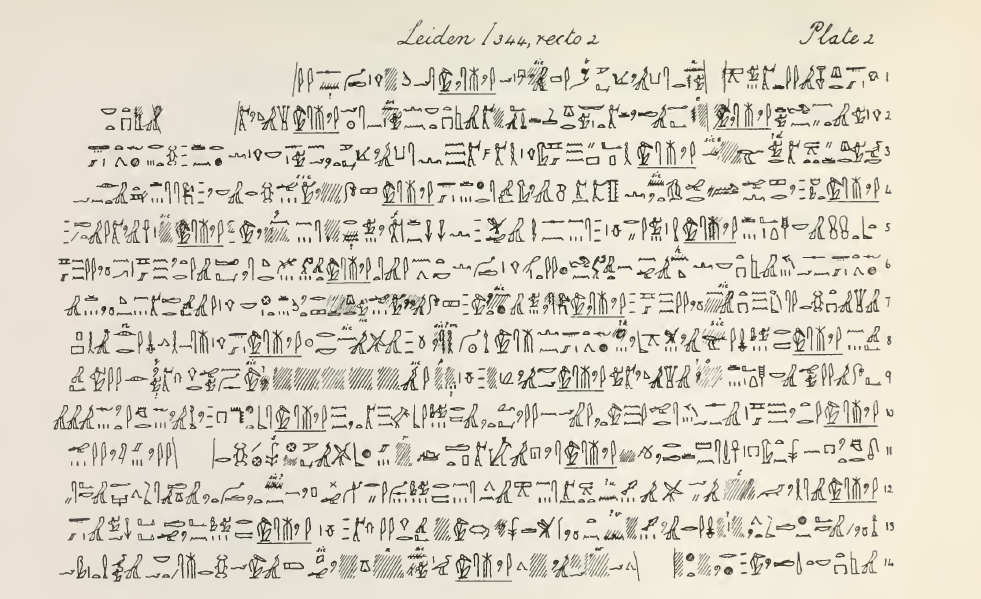
Gardiner also provided a hieroglyphic transcription of the hieratic text of Papyrus Leiden I 344, allowing the surviving manuscript to be compared directly with its corresponding hieroglyphic rendering. The example reproduced below is Plate 2 of his edition and corresponds to page 2 of the papyrus. The remaining pages can be cross-checked either against the surviving manuscript preserved in the Rijksmuseum van Oudheden in Leiden or against the complete series of transcription plates published at the end of Gardiner’s 1909 edition.
plate 1. (Papyrus Leiden I 344, page 1, lines 1-14)
| [… iryw]-aA Hr Sm n HAq n.n bnrytyw […] | […] door-keepers are going to “plunder for ourselves”; confectioners […] | […] οι θυρωροί πηγαίνουν να «λεηλατήσουν για λογαριασμό μας»· παρασκευαστές γλυκισμάτων […] |
| n Dd rxtyyw fAt Atpw.f n a[…] | The fullers refuse to carry his load […] | Οι γναφείς αρνούνται να μεταφέρουν το φορτίο του […] |
| [… grg?]-Apdw Ts n.sn skw […] | […] bird-trappers raise troops for themselves […] | […] οι κυνηγοί πουλιών συγκροτούν στρατεύματα για τους εαυτούς τους […] |
| […] idHw Hr ikmw atxw | The Delta-dwellers bear shields; brewers […] | Οι κάτοικοι του Δέλτα φέρουν ασπίδες· οι ζυθοποιοί […] |
| […] snm mAA s sA.f m xrwy.f sHA | […] nourishment; a man sees his son as his enemy; strife […] | […] τροφή· ένας άνθρωπος βλέπει τον γιο του ως εχθρό του· διαμάχη […] |
| […] swt ky mi Hr xpS wpwt […] | […] another, however. Come with the strength of a mission […] | […] ένας άλλος, όμως. Έλα με τη δύναμη μιας αποστολής […] |
| nAy SAt n.tn m rk Hr m hAw […] | […] those; what was ordained for you all in the reign of Horus, the time […] | […] εκείνοι· αυτό που είχε οριστεί για όλους εσάς κατά τη βασιλεία του Ώρου, την εποχή […] |
| […] Sm nb qd m irtyw m-a xprt m tA iw Sm […] | The master of restraint walks in mourning because of what is happening in the land. There went […] | Ο κύριος της αυτοσυγκράτησης περπατά πενθώντας εξαιτίας όσων συμβαίνουν στη χώρα. Πήγε […] |
| […] xAstyw (?) xpr m rmT m st nb iw ms Hr aAdw […] | Foreigners (?) have become Egyptians everywhere. Indeed, the face is pale […] | Ξένοι (?) έχουν γίνει Αιγύπτιοι παντού. Πράγματι, το πρόσωπο είναι χλωμό […] |
| […] .tw srT.n tpyw-a sprw r […] | […] what the ancestors foretold has drawn near […] | […] αυτό που προείπαν οι πρόγονοι έχει πλησιάσει […] |
| [iw ms …] rww (?) […] | Indeed, […] moving (?) […] | Πράγματι, […] κινείται (?) […] |
| […] | […] | […] |
| […] | […] | […] |
| […] | […] | […] |
source A. H. GARDINER – The Admonitions of an Egyptian Sage (archive.org)
plate 2. (Papyrus Leiden I 344, page 2, lines 1-14)
| […] tp tA Xr smAyw Sm s r skA in(?).f ikm.f iw ms sf Hr Dd sny […] | […] upon earth under plotters; a man goes to plough and takes his shield. Indeed, the merciful says: “Pass (?) […]” | […] πάνω στη γη κάτω από συνωμότες· ένας άνθρωπος πηγαίνει να οργώσει και παίρνει την ασπίδα του. Πράγματι, ο ελεήμων λέει: «Πέρασε (?) […]» |
| […] Hr.i m nty wn iw ms Hr aAdw pdt grg aDA m st nbt nn s n sf iw ms hAkw […] m st nbt | […] in my sight as one who exists. Indeed, the face is pale, the bow is ready; violence is everywhere, with no one from yesterday. Indeed, plunder […] everywhere. | […] στα μάτια μου σαν κάποιον που υπάρχει. Πράγματι, το πρόσωπο είναι χλωμό, το τόξο έτοιμο· η βία βρίσκεται παντού, χωρίς κανέναν από χθες. Πράγματι, λεηλασία […] παντού. |
| bAk Xry iT r gm.f iw ms Hapy Hr Hw n skA.tw n.f s nb Hr n rx.n xprt xt tA | The lowly servant steals as much as he finds. Indeed, Hapy (the Nile Flood) strikes, but no ploughing has been done for him; everyone says: “We do not know what is happening throughout the land.” | Ο ταπεινός υπηρέτης κλέβει όσο βρίσκει. Πράγματι, ο Χάπι (ο Κατακλυσμός του Νείλου) χτυπά, αλλά δεν έχει γίνει όργωμα γι’ αυτόν· όλοι λένε: «Δεν γνωρίζουμε τι συμβαίνει σε ολόκληρη τη χώρα». |
| iw ms Hmwt wSr n iwr.n.tw n qd.n Xnmw m-a sxrw tA iw ms SwAw xpr m nbw Spss tm irt n.f | Indeed, women are barren; none conceive. Khnum does not create because of the condition of the land. Indeed, beggars have become lords of riches; he who did not even have [sandals] made for him— | Πράγματι, οι γυναίκες είναι στείρες· καμία δεν συλλαμβάνει. Ο Χνουμ δεν δημιουργεί εξαιτίας της κατάστασης της χώρας. Πράγματι, οι επαίτες έχουν γίνει κύριοι πλούτου· εκείνος για τον οποίο δεν κατασκευάζονταν ούτε [σανδάλια]— |
| tbty m nb aHaw iw ms Hmw iry ib.sn snm n snsn.n srw rmT.sn nhm iw ms […] sxm iAdt | —is now a lord of wealth. Indeed, their servants, their hearts are fed; officials do not mingle with their people in celebration. Indeed, […] plague reigns— | —είναι τώρα κύριος πλούτου. Πράγματι, οι υπηρέτες τους, οι καρδιές τους είναι χορτασμένες· οι αξιωματούχοι δεν συναναστρέφονται τον λαό τους στη γιορτή. Πράγματι, […] η επιδημία κυριαρχεί— |
| xt tA snf m st nbt n kAn n mwt wnxyt Hr Dd n tkn im.st iw ms mwt aSA qrs m itrw nwy | —throughout the land; blood is everywhere; death is without limit, and the shroud speaks before it has been approached. Indeed, many dead are buried in the river; the floodwater— | —σε ολόκληρη τη χώρα· αίμα υπάρχει παντού· ο θάνατος δεν έχει όριο και το σάβανο μιλά πριν ακόμη το πλησιάσουν. Πράγματι, πολλοί νεκροί θάβονται στον ποταμό· τα νερά της πλημμύρας— |
| m HAt xpr is wabt m nwy iw ms Spsw m nxwt SwAw Hr rSwt niwt nb Hr imi dr.n qnw m | —are the tomb, while the embalming-place has become a flood. Indeed, nobles are in grief, beggars in joy; every town says: “Come, let us drive the powerful from—” | —είναι ο τάφος, ενώ ο τόπος ταρίχευσης έχει γίνει πλημμύρα. Πράγματι, οι ευγενείς πενθούν, οι επαίτες χαίρονται· κάθε πόλη λέει: «Ελάτε, ας διώξουμε τους ισχυρούς από—» |
| m-m.n iw ms rmT mi gmw sbw xt tA nn ms HD Hbsw n pA n rk iw ms tA Hr msnH mi nHp | “—among us.” Indeed, the people are like black ibises; filth pervades the land. Indeed, there is no one with white clothes in our time. Indeed, the land turns like a potter’s wheel. | «—ανάμεσά μας». Πράγματι, οι άνθρωποι είναι σαν μαύρες ίβιδες· η βρομιά απλώνεται σε ολόκληρη τη χώρα. Πράγματι, δεν υπάρχει κανείς με λευκά ενδύματα στην εποχή μας. Πράγματι, η χώρα γυρίζει σαν τον τροχό του αγγειοπλάστη. |
| awAy m nb aHaw […] m hAkw iw ms kfAw ibw […] iA […] nDs Hrw iry.i m | The weak man is now lord of riches; […] is the plunderer. Indeed, the trustworthy […] cry [out? …]; the small man is terrified: “What am I to do?” | Ο αδύναμος είναι τώρα κύριος πλούτου· […] είναι ο λεηλάτης. Πράγματι, οι αξιόπιστοι […] φωνάζουν [; …]· ο μικρός άνθρωπος τρομοκρατείται: «Τι να κάνω;» |
| iw ms itrw m snf swri.tw im.f nyw.tw m rmT ib.tw mw iw ms sbxt whAw Driwt Am | Indeed, the river is blood. Drinking from it, one recoils from people and thirsts for water. Indeed, gates, columns and walls are set on fire, | Πράγματι, ο ποταμός είναι αίμα. Πίνοντας από αυτόν, ο άνθρωπος αποστρέφεται τους ανθρώπους και διψά για νερό. Πράγματι, πύλες, κίονες και τοίχοι παραδίδονται στη φωτιά, |
| Drwt n pr nswt anx wDA snb mn rwd iw ms swhA dpt rsy xbA Sma xpr […]yw Swy | while the wall of the King’s House — life, prosperity, health! — remains firm and solid. Indeed, the ship of the south is capsized; Upper Egypt is hacked down and turned into dried ground. | ενώ ο τοίχος του Οίκου του Βασιλιά — ζωή, ευημερία, υγεία! — παραμένει σταθερός και ακλόνητος. Πράγματι, το πλοίο του Νότου έχει ανατραπεί· η Άνω Αίγυπτος έχει κατακοπεί και μετατραπεί σε ξερή γη. |
| iw ms msH[…]Afy pA rmw n iT.n.sn Sm n.sn rmT Ds iry HD pw n nn.tw Dd.tw m dgAs aA mk sy | Indeed, the crocodile[s?] are fat on fish and do not snatch, but people go to them of their own accord. This is destruction — or not! People say: “Do not walk here.” Look, there is— | Πράγματι, οι κροκόδειλοι (?) είναι χορτάτοι από ψάρια και δεν αρπάζουν, όμως οι άνθρωποι πηγαίνουν προς αυτούς με τη θέλησή τους. Αυτό είναι καταστροφή — ή μήπως όχι! Οι άνθρωποι λένε: «Μην περπατάς εδώ». Ιδού, υπάρχει— |
| Snw mk xnd.tw […] mi rmw n Tnw sw snd m-a Hry ib iw ms rmT and Dd sn.f m tA | —a net. Look, one treads […] like fish. The fearful man does not notice it because of the terror in his heart. Indeed, people are too few to place his brother in the ground— | —ένα δίχτυ. Ιδού, πατά κανείς […] σαν τα ψάρια. Ο φοβισμένος άνθρωπος δεν το αντιλαμβάνεται εξαιτίας του τρόμου στην καρδιά του. Πράγματι, οι άνθρωποι είναι τόσο λίγοι ώστε να βάλει κανείς τον αδελφό του στη γη— |
| m st nbt mdw rxw xt […]f […]f iw ms sA s […] gAw siA.f xpr ms nbt.f m sA Hmt.f | —everywhere. The wise speaks […] of him; his/he […]. Indeed, the son of a man […], his insight is lacking (?); the child of his lady has become the son of his servant-woman. | —παντού. Ο σοφός μιλά […] γι’ αυτόν· εκείνος/του […]. Πράγματι, ο γιος ενός ανθρώπου […], η αντίληψή του λείπει (?)· το παιδί της κυρίας του έχει γίνει γιος της υπηρέτριάς του. |
plate 3. (Papyrus Leiden I 344, page 3, lines 1-14)
| iw-ms dSrt xt tA spAt xbA pDtw rwty iy.ti n kmt iw-ms spr […] | Indeed, the desert is across the land; the nomes are devastated. Foreign bowmen have come into Egypt from outside. Indeed, […] have arrived. | Πράγματι, η έρημος απλώνεται σε όλη τη χώρα· οι νομοί έχουν ρημαχθεί. Ξένοι τοξότες ήρθαν στην Αίγυπτο απ’ έξω. Πράγματι, […] έχουν φτάσει. |
| […] nn ms wnn rmT m st nb iw-ms nbw xsbd HD mfkAt HmAgt Hsmn ibht […] n | There are indeed no Egyptians anywhere. Indeed, gold, lapis lazuli, silver, turquoise, precious stones, bronze, and stones of Yebhet […] | Δεν υπάρχουν πλέον Αιγύπτιοι πουθενά. Πράγματι, χρυσός, λάπις λάζουλι, ασήμι, τυρκουάζ, πολύτιμοι λίθοι, χαλκός και λίθοι της Γιεμπχέτ […] |
| mn xw r xx n Hmwt Spswt xt tA nbwt pr Hr Dd HA n.n wnm ti n.n iw-ms bw […] | adorn the necks of servant-women, while wealth is spread throughout the land. The ladies of the house say: “Would that we had something to eat!” Indeed, […] | στολίζουν τους λαιμούς των υπηρετριών, ενώ ο πλούτος είναι απλωμένος σε όλη τη χώρα. Οι κυρίες του σπιτιού λένε: «Αχ, να είχαμε κάτι να φάμε!» Πράγματι, […] |
| […] Spswt Haw.sn snmw m-a isywt ibw.sn btk Hr nD-xrt […] | […] noblewomen. Their bodies are in misery because of their rags; their hearts recoil at greetings. | […] ευγενείς γυναίκες. Τα σώματά τους υποφέρουν εξαιτίας των κουρελιών τους· οι καρδιές τους σφίγγονται όταν ανταλλάσσουν χαιρετισμούς. |
| iw-ms gmgm hnw nw hAbny ssndm Spst swA.tw.f m Atwt […] | Indeed, the chests of ebony are smashed to splinters; precious wood is torn apart for beds […] | Πράγματι, τα κιβώτια από έβενο έχουν συντριβεί σε θρύψαλα· το πολύτιμο ξύλο διαλύεται για κρεβάτια […] |
| […].sn iw-ms qdw aq m aHwtyw wnw m dpt nTr nHb […] n ms xd.tw r | They […]. Indeed, the builders have become field-workers; those who were on the god’s boat are now yoked. Today no one sails north to […] | Αυτοί […]. Πράγματι, οι οικοδόμοι έχουν γίνει εργάτες των αγρών· όσοι ήταν στη βάρκα του θεού έχουν τώρα ζευτεί. Σήμερα κανείς δεν πλέει βόρεια προς […] |
| kpny min ptr ir.ti.n r aSw n sahw.n qrs.tw wab[w m] inw.sn sdwx.tw | Byblos. What shall we do to obtain cedarwood for our mummies, with whose products the wab-priests are buried, and […] | τη Βύβλο. Τι θα κάνουμε για να αποκτήσουμε ξύλο κέδρου για τις μούμιές μας, με τα προϊόντα του οποίου θάβονται οι ιερείς wab, και […] |
| wrw m sft iry r mn m kftyw n ii.n.sn HD nbw qn wAH inyt nt kAt nb | […] with whose oils the great ones are embalmed, as far away as Keftiu? They no longer arrive. Gold is scarce; the materials for every kind of work are exhausted. | […] με τα έλαια του οποίου ταριχεύονται οι μεγάλοι, από τόσο μακριά όσο το Κεφτίου; Δεν φτάνουν πια. Ο χρυσός σπανίζει· τα υλικά για κάθε είδους εργασία έχουν εξαντληθεί. |
| kfA […] nt pr-nsw anx wDA snb wr wy iw wHAryw Xr Hbyt.sn tmAyw [sDrw] m rdmwt wAD | […] has been stripped from the King’s House — life, prosperity, and health! How good it is when the oasis-dwellers come with their festival offerings: mats, [sleeping-mats] of fresh redemet-plants, | […] έχει απογυμνωθεί από τον Οίκο του Βασιλιά — ζωή, ευημερία και υγεία! Πόσο καλό είναι όταν οι κάτοικοι των οάσεων έρχονται με τις προσφορές τους για τις γιορτές: ψάθες, [στρωσίδια] από φρέσκα φυτά redemet, |
| […] nw nw Apdw twrw-whAw iw-ms Abw Tny [spAw] smawt n bAk n | [jars] of birds and uprooted reeds. Indeed, Elephantine, Thinis, [and the nomes] of Upper Egypt do not pay tax | [δοχεία] με πουλιά και ξεριζωμένα καλάμια. Πράγματι, η Ελεφαντίνη, η Θινίς [και οι νομοί] της Άνω Αιγύπτου δεν πληρώνουν φόρο |
| [HA]ayt HD waH Dabt irtiw mAaw nwt StAw kAt Hmw DA[…] | because of strife. Carob, charcoal, blue minerals, maau-wood, nut-wood, and firewood are scarce. The works of the craftsmen […] | εξαιτίας της διαμάχης. Το ξύλο χαρουπιάς, το κάρβουνο, τα γαλάζια ορυκτά, το ξύλο maau, το ξύλο nut και τα καυσόξυλα σπανίζουν. Τα έργα των τεχνιτών […] |
| […qmyt] kmw aH iw pr HD r-m m xmt bAkw.f nfr is ib n nsw iw n.f mAat xr is | […] resins are lacking in the palace storehouses. Of what use is a treasury without its income? Truly, the heart of the king is glad when Maat comes to him. | […] ρητίνες λείπουν από τις αποθήκες του παλατιού. Τι νόημα έχει ένας θησαυρός χωρίς έσοδα; Πραγματικά, η καρδιά του βασιλιά χαίρεται όταν η Μαάτ έρχεται σε αυτόν. |
| […] xAst nb mw.n pw wAD.n pw ptr ir.ti.n r.s wAw r Aqw iw-ms sbt Aqw | […] every foreign land. “That is our water, that is our prosperity.” What are we to do about it? All has fallen into ruin. Indeed, laughter has perished, | […] κάθε ξένη χώρα. «Αυτό είναι το νερό μας, αυτή είναι η ευημερία μας». Τι μπορούμε να κάνουμε γι’ αυτό; Όλα έχουν πέσει σε ερείπια. Πράγματι, το γέλιο έχει χαθεί, |
| n ir.tw.f im pw nty xt tA Sbn Hr nxwt iw-ms [iwty] nb m nty wn wnw m | it will be made no more. It is lamentation that fills the land, mingled with wailing. Indeed, every outsider is now a man of standing; those who were […] | και δεν θα υπάρξει πια. Είναι θρήνος αυτό που γεμίζει τη χώρα, ανακατεμένος με οδυρμούς. Πράγματι, κάθε ξένος / ασήμαντος είναι τώρα άνθρωπος κύρους· εκείνοι που ήταν […] |
plate 4. (Papyrus Leiden I 344, page 4, lines 1-14)
| rmT kwy di.tw Hr wAt iw ms Sny […] n Hr nb n tn.n.tw sA s r iwty n.f sw iw ms […] | People have become strangers, cast onto the road. Indeed, everyone has dishevelled hair; the son of a man cannot be distinguished from one without. Indeed, […] | Οι άνθρωποι έχουν γίνει ξένοι, ριγμένοι στον δρόμο. Πράγματι, όλοι έχουν ανακατεμένα μαλλιά· ο γιος ενός ανθρώπου δεν μπορεί να διακριθεί από εκείνον που δεν είναι. Πράγματι, […] |
| Hr xrw n aqA xrw m rnpwt nt xrw nn pHwy xrw iw ms Xrd Sri mr.i mwt.i Xrdw kty […] | […] at the voice. Voices are not straight in the years of voices; there is no end to voices. Indeed, the little child says: “I wish I were dead”; children of strangers (?) […] | […] στη φωνή. Οι φωνές δεν είναι σταθερές στα χρόνια των φωνών· δεν υπάρχει τέλος στις φωνές. Πράγματι, το μικρό παιδί λέει: «Μακάρι να ήμουν νεκρό»· παιδιά ξένων (?) […] |
| Hr Tmw sw r rdi anx iw ms mswt […] srw Hw.tw r sAwt Xrdw nw nHbt diw Hr qAnr | […] say: “He ought not to have given life.” Indeed, the babies [of?] officials are struck against the walls; nursing infants are cast onto the pile. | […] λένε: «Δεν έπρεπε να είχε δώσει ζωή». Πράγματι, τα βρέφη [των?] αξιωματούχων χτυπιούνται πάνω στους τοίχους· τα βρέφη που ακόμη θηλάζουν ρίχνονται στον σωρό. |
| iw ms wn m wabt [di].tw Hr qAnr sStAw pw n wtw Hr sxr Hr.f iw ms | Indeed, the one who was in the embalming-chapel is [cast] onto the pile, and the secrets of the embalmers are overturned with him. Indeed | Πράγματι, εκείνος που βρισκόταν στον χώρο ταρίχευσης [ρίχνεται] στον σωρό, και μαζί του ανατρέπονται τα μυστικά των ταριχευτών. Πράγματι |
| nfAy Aqw mAA m sf tA spw n g[nwt].f mi wHAt mH m isw (?) iw ms | those things have perished that were seen only yesterday; the land is left to its [weakness], like the plucking of flax from the reeds (?). Indeed | εκείνα τα πράγματα που μόλις χθες μπορούσε κανείς να δει έχουν χαθεί· η χώρα έχει αφεθεί στην [αδυναμία] της, όπως το ξερίζωμα του λιναριού από τα καλάμια (?). Πράγματι |
| idHw r Dr.f nn dgAy.tw.f mH ib n tA mHw m mTnw Hw ptr | the entire Delta is no longer recognisable; the security of Lower Egypt is now only well-trodden roads. What | ολόκληρο το Δέλτα δεν είναι πλέον αναγνωρίσιμο· η ασφάλεια της Κάτω Αιγύπτου είναι τώρα μόνο πολυπατημένοι δρόμοι. Τι |
| nty tw r irt n xpr […] m st nbt xr.tw Dd.tw wA r st StAw mk sw m-a xmw sw mi rxw sw | is to be done? No […] happens anywhere, and so it is said: “Woe to the place of secrets.” Look, it is the same with those ignorant of it as with those who know it. | μπορεί να γίνει; Δεν […] συμβαίνει πουθενά, και έτσι λέγεται: «Αλίμονο στον τόπο των μυστικών». Ιδού, το ίδιο συμβαίνει με εκείνους που δεν το γνωρίζουν όπως και με εκείνους που το γνωρίζουν. |
| xAstyw Hmw m kAt idHw iw ms di.tw Xnmw Hr bnwyt Hbsy pA | Foreigners are now skilled in the arts of the Delta. Indeed, families are set to the grindstone; wearers of fine | Οι ξένοι είναι τώρα επιδέξιοι στις εργασίες του Δέλτα. Πράγματι, οικογένειες τοποθετούνται στη μυλόπετρα· εκείνοι που φορούσαν εκλεκτό |
| qt Hw.tw m DAwt tmy mAA hrw pr n [xsf] wnyw Hr Hnkyt nt hA | linen are beaten with sticks. Those who never saw daylight go out unrestrained. Those who were on the beds of their— | λινό χτυπιούνται με ραβδιά. Εκείνοι που ποτέ δεν έβλεπαν το φως της ημέρας βγαίνουν ανεμπόδιστα. Εκείνες που βρίσκονταν στα κρεβάτια των— |
| iw.sn imi sDr.sn Hr Sdw […] m-a mtw Dd.i iw.f dns r.i Sdw Xry antyw | —husbands: let them sleep on rafts […]. I say: “It is harder for me than timbers.” The wearer of scented oil— | —συζύγων τους: ας κοιμηθούν πάνω σε σχεδίες […]. Λέω: «Είναι για μένα σκληρότερο από τα ξύλα». Εκείνη που φορούσε αρωματικό έλαιο |
| iwh st Xr anDw mH Xr […] rx st qniw xr wbAw HD sw nfr pw | —is laden down with jars, filled with […]; she [no longer?] recognises a carrying-chair. The servants are gone, so there is no remedy for it. | είναι φορτωμένη με δοχεία, γεμάτα με […]· [δεν αναγνωρίζει πλέον;] ένα φορείο. Οι υπηρέτες έχουν φύγει, κι έτσι δεν υπάρχει θεραπεία γι’ αυτό. |
| pHrt iry snni n.sn Spswt mi bAkwt xnyt m miAt m Xnw nAt Hst.sn | Noblewomen are brought down like servant-women. Musicians are at the looms inside the weaving-factories; their song | Οι ευγενείς γυναίκες έχουν υποβιβαστεί σαν υπηρέτριες. Οι μουσικοί βρίσκονται στους αργαλειούς μέσα στα εργαστήρια ύφανσης· το τραγούδι τους |
| n mrt m irtyw.sy Ddw […] Hr bnwyt iw ms Hmwt nbt sxm m rw.sn mdw | is lamentation at the fringe, saying […] at the grindstones. Indeed, all servant-women possess power in their speech, when | είναι θρήνος στο τελείωμα, λέγοντας […] στις μυλόπετρες. Πράγματι, όλες οι υπηρέτριες έχουν εξουσία στον λόγο τους, όταν |
| Hnwt.sn dns pw r bAkw iw ms [nh?]wt sk gnw wnw iwd.n.i sw Hmw n | their mistresses speak. It is harder than forced labour. Indeed, [sycamore?] trees are cut down, the branches stripped bare. I have abandoned it—the servants of— | μιλούν οι κυρίες τους. Είναι σκληρότερο από καταναγκαστική εργασία. Πράγματι, [συκομουριές;] κόβονται και τα κλαδιά μένουν γυμνά. Το έχω εγκαταλείψει — τους υπηρέτες του— |
plate 5. (Papyrus Leiden I 344, page 5, lines 1-14)
| pr.f iw rmT r Dd sDm.sn st HD fqAw n HAw n Xrdw nn kAw n[kawt…] | his house. People will say when they hear it: “Cakes are lacking for most of the children; there is no food, nor [sycamore figs …]” | του σπιτιού του. Οι άνθρωποι θα πουν όταν το ακούσουν: «Λείπουν τα ψωμάκια για τα περισσότερα παιδιά· δεν υπάρχει τροφή ούτε [σύκα συκομουριάς …]» |
| iw min dpt iry mi-m min iw ms srw Hqrw Hr swn Sms.tw Smswt.st sqn […] | Today, how does it taste, today? Indeed, the officials are starving and in distress; their attendants are now served. […] grows strong | Σήμερα, τι γεύση έχει αυτό σήμερα; Πράγματι, οι αξιωματούχοι πεινούν και υποφέρουν· οι ακόλουθοί τους τώρα υπηρετούνται. […] δυναμώνει |
| Hr nxwt iw ms tAw Hr Dd ir siA.i rx n.i nTr Tn kA iry.i n.f iw ms mAat xt | through lamentations. Indeed, the hot-tempered man says: “If I could perceive and know where the god is, then I would act for him.” Indeed, Maat is spread | μέσα από θρήνους. Πράγματι, ο οξύθυμος άνθρωπος λέει: «Αν μπορούσα να αντιληφθώ και να γνωρίζω πού βρίσκεται ο θεός, τότε θα ενεργούσα γι’ αυτόν». Πράγματι, η Μαάτ απλώνεται |
| tA m rn.st pwy isft pw ir.sn Hr grg Hr.st iw ms sxsw aHA Hr n Hn[w…] | throughout the land in this its name, but it is Isfet on which they base their actions. Indeed, one runs and fights for property […] | σε ολόκληρη τη χώρα με αυτό το όνομά της, αλλά πάνω στην Ισφέτ βασίζουν τις πράξεις τους. Πράγματι, κάποιος τρέχει και μάχεται για περιουσία […] |
| awAy(t) it.tw xt.f nbt iw ms awt nbt ibw.sn rmw mnmnt Hr im m-a sxr tA | the robbed man has all his possessions taken. Indeed, all the herds, their hearts weep; the cattle groan because of the condition of the land. | από τον ληστεμένο αρπάζονται όλα τα υπάρχοντά του. Πράγματι, όλα τα κοπάδια, οι καρδιές τους κλαίνε· τα ζώα στενάζουν εξαιτίας της κατάστασης της χώρας. |
| iw ms msw srw Hw.tw r sAwt Xrdw nw nHbt di.tw Hr qAnr Xnmw Hr im | Indeed, the children of officials are struck against the walls; nursing infants are cast onto the pile. Khnum groans | Πράγματι, τα παιδιά των αξιωματούχων χτυπιούνται πάνω στους τοίχους· τα βρέφη που ακόμη θηλάζουν ρίχνονται στον σωρό. Ο Χνουμ στενάζει |
| Hr wrdw.f iw ms Sat smA.st snD Hr xsf irw r xftyw.tn iw grt and twtw | in his weariness. Indeed, terror kills them. Fear repels those who act against your enemies. Moreover, images | από την εξάντλησή του. Πράγματι, ο τρόμος τους σκοτώνει. Ο φόβος απωθεί εκείνους που ενεργούν εναντίον των εχθρών σας. Επιπλέον, οι εικόνες |
| wt wDA Hr nty ktw in iw m Sms n xnty Hna wDa.f in iw m rxs n mAiw ASr n sD in iw | and amulets are of little use. Is it in serving Khenty together with his slayer? Is it in slaughtering a lion and roasting it in flame? Is it | και τα φυλακτά έχουν μικρή χρησιμότητα. Είναι άραγε στην υπηρεσία του Χέντυ μαζί με εκείνον που σκοτώνει; Είναι στη σφαγή ενός λιονταριού και στο ψήσιμό του στη φωτιά; Είναι |
| m iwH n ptH iTt i[…] di.tn n.f Hr m n pH sw indw is pw di.tn n.f iw ms [Hm] | in making libations to Ptah and taking […]? Why do you give it to him? It does not reach him; what you give him is indeed wretched. Indeed, [servants]— | στις σπονδές προς τον Πτα και στην αρπαγή […] ; Γιατί του το δίνετε; Δεν τον φτάνει· αυτό που του δίνετε είναι πράγματι άθλιο. Πράγματι, [υπηρέτες]— |
| […] xt tA nxt Hr hAb n bw-nb Hw s sn.f n mwt.f iSst pw iryt Dd […] | —[…] throughout the land. The strong man sends word to everyone. A man strikes his maternal brother. “What has been done?” says […] | —[…] σε ολόκληρη τη χώρα. Ο ισχυρός στέλνει μήνυμα σε όλους. Ένας άνθρωπος χτυπά τον αδελφό του από τη μητέρα του. «Τι έχει γίνει;» λέει […] |
| .i n Akw iw ms wAwt [nw] mTnw sAw Hms.tw Hr bAwt r iit.tw xAwy | “I say to the wretched man.” Indeed, the ways are [watched] and the roads guarded; they sit in the bushes awaiting the arrival of the night-traveller | «Λέω στον δυστυχισμένο άνθρωπο». Πράγματι, οι δρόμοι [παρακολουθούνται] και οι διαδρομές φυλάσσονται· κάθονται μέσα στους θάμνους περιμένοντας να φτάσει ο νυχτερινός ταξιδιώτης |
| r iTt ATpw.f nHmw nty Hr.f xnmw m sxt xt Xdbw m nf iw ms nfAy | to steal his load. What is on him is seized; he is beaten with blows of the stick and unlawfully killed. Indeed | για να αρπάξουν το φορτίο του. Ό,τι έχει πάνω του αρπάζεται· ξυλοκοπείται με χτυπήματα ραβδιού και δολοφονείται άδικα. Πράγματι |
| Akw mAA sf tA spw n gnwt.f mi wHA mHy nDsw pryw | those things that could be seen yesterday have perished. The land is left to its weakness, like the plucking of flax. The lowly go out | εκείνα που μπορούσε κανείς να δει χθες έχουν χαθεί. Η χώρα έχει αφεθεί στην αδυναμία της, όπως όταν ξεριζώνεται το λινάρι. Οι κατώτεροι βγαίνουν |
| Hr swn nby [……m-a nw] HA rf grH pw m rmT n iwr n | in distress; […]. If only this were the end of mankind: no conception and no— | μέσα στην οδύνη· […]. Μακάρι αυτό να ήταν το τέλος της ανθρωπότητας: καμία σύλληψη και καμία— |
plate 6. (Papyrus Leiden I 344, page 6, lines 1-14)
| mst ix gr tA m xrw nn Xnnw iw ms [wnm.tw] m smw sAmw.tw m mw n | —birth. Then the land would be silent of voices, without turmoil. Indeed, one eats plants and swallows them with water; one | —γέννηση. Τότε η χώρα θα έμενε σιωπηλή από φωνές, χωρίς αναταραχή. Πράγματι, οι άνθρωποι τρώνε φυτά και τα καταπίνουν με νερό· κανείς |
| gm.n.tw qAy smw [n] Apdw nHm.tw pryt m r n SAiw n Hr an n.k st r.i | cannot find grain or plants for birds; seed is taken from the mouths of pigs. Your face is no brighter than mine | δεν μπορεί να βρει σιτηρά ούτε φυτά για τα πουλιά· οι σπόροι αφαιρούνται από τα στόματα των χοίρων. Το πρόσωπό σου δεν είναι πιο φωτεινό από το δικό μου |
| xr Hkrw iw ms it Aqw Hr wAt nb sHAw m Hbsw XsA m mrHt Hr nbw | because of hunger. Indeed, grain has perished on every road; the one stripped of clothing is anointed with oil. Everyone | εξαιτίας της πείνας. Πράγματι, τα σιτηρά έχουν χαθεί σε κάθε δρόμο· εκείνος που στερείται ενδύματα αλείφεται με έλαιο. Όλοι |
| Hr nn wn wDA fk sAw.f pD r tA [nn] smw mAr pw n ib.i iw.i Dr | says: “There is nothing.” The storeroom is bare, its guard stretched out on the ground. This is not good for my heart. I am utterly— | λένε: «Δεν υπάρχει τίποτε». Η αποθήκη είναι άδεια και ο φύλακάς της είναι ξαπλωμένος στο έδαφος. Αυτό δεν είναι καλό για την καρδιά μου. Έχω εντελώς |
| r-sy HA rf ir.n.i xrw.i m tAy At nHm.f wi m-a wxdt irw im st iw ms xnti Dsr Sd | come to the end. If only I had raised my voice at that moment, it would have saved me from the suffering inflicted there. Indeed, the Sacred Chamber, | φτάσει στα όριά μου. Αν είχα υψώσει τη φωνή μου εκείνη τη στιγμή, θα με είχε σώσει από την οδύνη που μου προκλήθηκε εκεί. Πράγματι, ο Ιερός Θάλαμος, |
| sSw.f sHAw st StAw wnt iw ms HkAw sHAw Smw sxnw snHA.tw Hr sxA st in rmT | its writings are removed and the secrets of the place exposed. Indeed, spells are laid bare, pronouncements and incantations are gone; they are rendered ineffective | τα γραπτά του αφαιρούνται και τα μυστικά του τόπου αποκαλύπτονται. Πράγματι, οι μαγικές ρήσεις αποκαλύπτονται, οι διακηρύξεις και οι επωδές χάνονται· καθίστανται ανίσχυρες |
| iw ms wn xA Sd wptwt.s xpr rmT Dt m nb | when people remember them. Indeed, the bureau is open, its inventories removed; dependent workers have become owners of | όταν οι άνθρωποι τις ανακαλούν. Πράγματι, το γραφείο είναι ανοικτό και οι κατάλογοί του έχουν αφαιρεθεί· οι εξαρτημένοι εργάτες έχουν γίνει κύριοι |
| Dt iw ms [sSw] smA.tw Sd sSw.sn bin wy n.i n indw m [r]k iry iw ms | dependents. Indeed, [scribes] are killed and their writings removed. How terrible it is for me, the misery of such a time! Indeed | εξαρτημένων. Πράγματι, [γραφείς] σκοτώνονται και τα γραπτά τους αφαιρούνται. Πόσο τρομερή είναι για μένα η δυστυχία μιας τέτοιας εποχής! Πράγματι |
| sSw nw tmA dr sSw.sn anxt n kmt m hAy.i in.tw n.i iw ms hpw | the land-register scribes, their writings have been destroyed. The grain of Egypt is now: “I go down and get it.” Indeed, the laws | των γραφέων του κτηματολογίου τα γραπτά έχουν καταστραφεί. Τα σιτηρά της Αιγύπτου είναι τώρα: «Κατεβαίνω και τα παίρνω». Πράγματι, οι νόμοι |
| nw xnrt diw xnty Sm.tw [m] ms Hr.sn m iwyt Hwrw Hr ngt im m Xnw | of the Council Hall are cast out; people walk over them in the public places, while the poor tear them apart in the street. | της Αίθουσας του Συμβουλίου πετιούνται έξω· οι άνθρωποι περπατούν πάνω τους στους δημόσιους χώρους, ενώ οι ταπεινοί τούς σκίζουν μέσα στον δρόμο. |
| m mrwtA iw ms Hwrw spr r a psDt sHAw sSmw pf mabAyt | Indeed, the poor have reached the position of the Ennead, and the procedures of the House of Thirty have been laid bare. | Πράγματι, οι ταπεινοί έχουν φτάσει στη θέση της Εννεάδας και οι διαδικασίες του Οίκου των Τριάκοντα έχουν αποκαλυφθεί. |
| iw ms xnrt wr m pr hA.f Hwrw Hr Smt iit m Hwt wryt iw ms | Indeed, the Great Council Hall is now a place of free entry; the poor come and go in the Great Halls. Indeed | Πράγματι, η Μεγάλη Αίθουσα του Συμβουλίου είναι πλέον τόπος ελεύθερης εισόδου· οι ταπεινοί μπαινοβγαίνουν στις Μεγάλες Αίθουσες. Πράγματι |
| msw srw xAa m mrwt rx Hr tiw wxA Hr m-biA nty n rx.f sy an | the children of officials are cast into the streets. The wise says “yes”, the fool says “no”; he who knows nothing of it is content. | τα παιδιά των αξιωματούχων εγκαταλείπονται στους δρόμους. Ο σοφός λέει «ναι», ο ανόητος λέει «όχι»· ευχαριστημένος είναι εκείνος που δεν γνωρίζει τίποτε γι’ αυτό. |
| m Hr.f iw ms wnw m wabt di.tw Hr qAnr sStAw pw n wtw Hr sxrw Hr.f | Indeed, those who were in the embalming-chapel are cast onto the pile, and the secrets of the embalmers are overturned with them. | Πράγματι, όσοι βρίσκονταν στον χώρο ταρίχευσης ρίχνονται στον σωρό και μαζί τους ανατρέπονται τα μυστικά των ταριχευτών. |
plate 7. (Papyrus Leiden I 344, page 7, lines 1-14)
| mTn-is xt wA.ti r qA pr wbdt.s r xftyw tA mTn-is ir xt n pA xpr wA(w) Sd | See, indeed: the flame has risen high; its scorching goes out against the enemies of the land. See, indeed: things have been done that had never happened before: the king has been removed | Ιδού, πράγματι: η φωτιά υψώθηκε ψηλά· η καύση της στρέφεται εναντίον των εχθρών της χώρας. Ιδού, πράγματι: έχουν γίνει πράγματα που ποτέ πριν δεν είχαν συμβεί: ο βασιλιάς έχει απομακρυνθεί |
| nsw in Hwrw mTn qrs m bik m Sfdt iw imnt n mr wAr Swt mTn-is wA sSwA | by the lowly. See: he who was buried as a Falcon is now in a wooden coffin; what the pyramid concealed has been left empty. See, indeed: there has been deprivation | από τους ταπεινούς. Ιδού: εκείνος που είχε ταφεί ως Γεράκι βρίσκεται τώρα σε ξύλινο φέρετρο· ό,τι έκρυβε η πυραμίδα έχει μείνει άδειο. Ιδού, πράγματι: έχει στερηθεί |
| tA m nsyt in nhy n rmT xmw n sxr mTn-is wA r sbi Hr iart nxt nt ra shr | the land of kingship by a few people ignorant of proper conduct. See, indeed: rebellion has arisen against the mighty uraeus of Ra, which pacifies | η χώρα τη βασιλεία της από λίγους ανθρώπους που αγνοούν την ορθή τάξη. Ιδού, πράγματι: έχει ξεσπάσει εξέγερση εναντίον του ισχυρού ουραίου του Ρα, ο οποίος ειρηνεύει |
| tAwy mTn sStAw n tA xm Drw.f sHAw Xnw whn.n.f n wnwt mTn kmt wA.ti r | the Two Lands. See: the secrets of the land, whose limits were unknown, have been revealed; the Residence has been laid bare and collapsed in a single moment. See: Egypt has been reduced to | τις Δύο Χώρες. Ιδού: τα μυστικά της χώρας, της οποίας τα όρια ήταν άγνωστα, έχουν αποκαλυφθεί· η Έδρα έχει απογυμνωθεί και κατέρρευσε μέσα σε μία στιγμή. Ιδού: η Αίγυπτος έχει καταντήσει να |
| stt mw di mw r tA iT.n.f nxt a m mAir mTn Sd qrHt m tpHt.s sHAw sStA n | pour water; he who used to pour water onto the ground has brought the strong-armed man into misery. See: Kerehet has been removed from her cavern; the secrets of | χύνει νερό· εκείνος που άλλοτε έχυνε νερό στη γη έφερε τον ισχυρό στα χέρια άνθρωπο στη δυστυχία. Ιδού: η Κερεχέτ έχει απομακρυνθεί από το σπήλαιό της· τα μυστικά των |
| nsyw bityw mTn Xnw Hr snD m-a gAwt nb.i r wd HAayt nn xsf | the Kings of Upper and Lower Egypt have been revealed. See: the Residence is afraid because of want, but my lord will set forth battle without opposition. | Βασιλέων της Άνω και Κάτω Αιγύπτου έχουν αποκαλυφθεί. Ιδού: η Έδρα φοβάται εξαιτίας της έλλειψης, αλλά ο κύριός μου θα εξαπολύσει μάχη χωρίς αντίσταση. |
| mTn tA Ts.n.f Xr smAy qn Xsy Hr nHm [xt].f mTn qrHt Hr [mw mi] nnyw | See: the land has bound itself beneath conspirators; the coward seizes the [possessions] of the valiant. See: Kerehet is upon the [water like] the weary. | Ιδού: η χώρα έχει δεθεί κάτω από συνωμότες· ο δειλός αρπάζει τα [υπάρχοντα] του γενναίου. Ιδού: η Κερεχέτ βρίσκεται πάνω στο [νερό σαν] τους εξαντλημένους. |
| tm ir.n.f DbAt m nb HAt mTn nbw wabwt dr Hr qAnr tm ir.n.f qrs m [nb] pr-HD | He who could not make a sarcophagus for himself is now lord of a tomb. See: the lords of the embalming-halls are driven onto the high ground; he who could not arrange a burial for himself is now [lord] of a treasury. | Εκείνος που δεν μπορούσε να κατασκευάσει για τον εαυτό του σαρκοφάγο είναι τώρα κύριος τάφου. Ιδού: οι κύριοι των χώρων ταρίχευσης οδηγούνται στα υψώματα· εκείνος που δεν μπορούσε να εξασφαλίσει ταφή για τον εαυτό του είναι τώρα [κύριος] θησαυροφυλακίου. |
| mTn-is nA xpr(w) rmT tm qd.n.f at m nb Dryt mTn qnbt nt tA dr.ti xt tA dr m pryt | See, indeed, what people have become: he who could not build a room for himself is now lord of walls. See: the magistrates of the land are driven throughout the land, driven from the estates | Ιδού, πράγματι, τι έχουν γίνει οι άνθρωποι: εκείνος που δεν μπορούσε να χτίσει ένα δωμάτιο για τον εαυτό του είναι τώρα κύριος τοίχων. Ιδού: οι άρχοντες της χώρας εκδιώκονται σε ολόκληρη τη χώρα, εκδιώκονται από τα κτήματα |
| nswywt mTn Spswt Hr Sdw srw m Sna tm sDr Hr Drywt m nb Hnkyt mTn nb xt | of the kings. See: noblewomen are on rafts and officials in the storerooms. He who never slept even on walls is now lord of bedding. See: the lord of possessions | των βασιλέων. Ιδού: οι ευγενείς γυναίκες βρίσκονται πάνω σε σχεδίες και οι αξιωματούχοι στις αποθήκες. Εκείνος που δεν κοιμόταν ούτε πάνω σε τοίχους είναι τώρα κύριος κλινοσκεπασμάτων. Ιδού: ο κύριος των αγαθών |
| sDr ib dbH.n.f tAHw.f m nb sxrw mTn nbw DAywt m isywt tm | goes to sleep thirsty, while he who begged for his dregs is now lord of overflowing vessels. See: the owners of garments are in rags, while he who | πηγαίνει για ύπνο διψασμένος, ενώ εκείνος που ζητιάνευε τα κατακάθια του είναι τώρα κύριος ξεχειλισμένων δοχείων. Ιδού: οι κύριοι των ενδυμάτων βρίσκονται σε κουρέλια, ενώ εκείνος που |
| sxt.n.f m nb pAqt mTn tm mDH.n.f imw m nb aHaw nb iry Hr gmH st nn st m-a.f | had nothing woven for himself is now lord of fine linen. See: he who could not have a boat built for himself is now lord of a fleet; its former owner looks at it, but it is no longer his. | δεν είχε τίποτε υφασμένο για τον εαυτό του είναι τώρα κύριος εκλεκτού λινού. Ιδού: εκείνος που δεν μπορούσε να κατασκευάσει για τον εαυτό του πλοίο είναι τώρα κύριος στόλου· ο προηγούμενος ιδιοκτήτης του τον κοιτάζει, αλλά δεν είναι πλέον δικός του. |
| mTn iwty Swyt.f m nb Swyt nbw Swyt m wxA n Daw mTn xm DADAt m nb bnt | See: he who had no shade is now lord of shade, while the lords of shade are exposed to the blasts of storm-winds. See: he who knew no lyre is now lord of a harp | Ιδού: εκείνος που δεν είχε σκιά είναι τώρα κύριος σκιάς, ενώ οι κύριοι της σκιάς είναι εκτεθειμένοι στα χτυπήματα των θυελλωδών ανέμων. Ιδού: εκείνος που δεν γνώριζε λύρα είναι τώρα κύριος άρπας |
| tm Hsy n.f Hr swhA mrt mTn nbw wDHw m Hmti n wnx hnw n wa im mTn sDr | and he who could not have anyone sing for him now glorifies Meret. See: the owners of copper offering-stands no longer have even a single vessel adorned. See: he who used to sleep— | και εκείνος που δεν μπορούσε να έχει κάποιον να τραγουδήσει γι’ αυτόν τώρα δοξάζει τη Μερέτ. Ιδού: οι κύριοι χάλκινων σκευών προσφορών δεν έχουν πλέον ούτε ένα στολισμένο δοχείο. Ιδού: εκείνος που συνήθιζε να κοιμάται— |
plate 8. (Papyrus Leiden I 344, page 8, lines 1-14)
| xAry m-a gAwt gm.f Spssw tm n.f mAA aHa Hr swdn mTn iwty xt.f m nb axaw | —as a widower through deprivation, now finds wealth. He who could not be seen standing is now a man of importance. See: he who had nothing is now lord of wealth, | —ως χήρος μέσα στη στέρηση, τώρα βρίσκει πλούτο. Εκείνος που δεν μπορούσε να εμφανιστεί όρθιος είναι τώρα άνθρωπος κύρους. Ιδού: εκείνος που δεν είχε τίποτε είναι τώρα κύριος πλούτου, |
| sr Hr Hst.f mTn SwAw nw tA xpr m xwdw [nb] xt m iwty n.f mTn [wd]pw | and the official praises him. See: the poor of the land have become wealthy, while the owner of property is now one who has nothing. See: the stewards | και ο αξιωματούχος τον επαινεί. Ιδού: οι φτωχοί της χώρας έχουν γίνει πλούσιοι, ενώ εκείνος που κατείχε περιουσία τώρα δεν έχει τίποτε. Ιδού: οι οικονόμοι |
| xpr m nbw wbAw wn m wpwty Hr hAb ky mTn iwty pat.f m nb mXr Hn.n(tw) | have become masters of servants. He who was a messenger now sends another. See: he who had no loaf of his own is now lord of a granary, and his storehouse is being | έχουν γίνει κύριοι υπηρετών. Εκείνος που ήταν αγγελιαφόρος τώρα στέλνει άλλον. Ιδού: εκείνος που δεν είχε δικό του καρβέλι είναι τώρα κύριος σιταποθήκης και η αποθήκη του |
| Sna.f m xt ky mTn wS Sny iwty mrHt.f xpr m nb xbbwt antyw nDm | provisioned with the goods of another. See: the man with dishevelled hair, who had no oil of his own, has become lord of great jars of sweet myrrh. | εφοδιάζεται με τα αγαθά κάποιου άλλου. Ιδού: ο άνθρωπος με τα ανακατεμένα μαλλιά, που δεν είχε δικό του έλαιο, έχει γίνει κύριος μεγάλων αγγείων γλυκιάς μύrrας. |
| mTn iwty(t) m pds.s m nbt Atp gmH Hr.s mw m nbt anx [mTn isx] mTn nfr s Hr wnm | See: she who had no box of her own is now mistress of furnishings; she who looked at her face in the water is now mistress of a mirror. [See …] See: a man is happy when eating | Ιδού: εκείνη που δεν είχε δικό της κιβώτιο είναι τώρα κυρία επίπλων· εκείνη που κοιτούσε το πρόσωπό της στο νερό είναι τώρα κυρία καθρέφτη. [Ιδού …] Ιδού: ένας άνθρωπος είναι ευτυχισμένος όταν τρώει |
| kAw.f snm xt.k m Aw-ib nn n.k HnHn r.k Ax pw n s wnm kAw.f wD(w) sw nTr n | his food. Eat your food in joy, with no one to hinder you. It is beneficial for a man to eat his food; the god commands it for | την τροφή του. Φάε την τροφή σου με χαρά, χωρίς κανέναν να σε εμποδίζει. Είναι ωφέλιμο για έναν άνθρωπο να τρώει την τροφή του· ο θεός το ορίζει για |
| Hsy n.f […………..mTn-is xm] nTr.f Hr wdnw n.f m snTr n ky n rx […] m | the one he has favoured. […] [See, indeed: one who did not know] his god now offers him incense belonging to another, while one who did not know […] See | εκείνον που έχει ευνοήσει. […] [Ιδού, πράγματι: εκείνος που δεν γνώριζε] τον θεό του τώρα του προσφέρει θυμίαμα που ανήκει σε άλλον, ενώ εκείνος που δεν γνώριζε […] Ιδού |
| Tn Sps(w)t wryt nbt Spss(w) Hr rdi n msw.sn n Hnk(w)t mTn-is s […………..] | great noblewomen, owners of wealth, give their children in exchange for bedding. See, indeed: a man […] | μεγάλες ευγενείς γυναίκες, κυρίες πλούτου, δίνουν τα παιδιά τους με αντάλλαγμα κλινοσκεπάσματα. Ιδού, πράγματι: ένας άνθρωπος […] |
| Spst m Hmt nx n sw it.s iwty Hr smA.f mTn msw qnbt m is[ywt] | —[takes] a noblewoman as wife; her father has protected him, but a destitute man is killing him (?). See: the children of the council are in [rags]. | —[παίρνει] μια ευγενή γυναίκα ως σύζυγο· ο πατέρας της τον έχει προστατεύσει, αλλά ένας άπορος άνθρωπος τον σκοτώνει (?). Ιδού: τα παιδιά του συμβουλίου βρίσκονται μέσα σε [κουρέλια]. |
| [kAw] nw Hww.sn n HAkyw mTn nsyw Hr qnqn m kAw mAir […….HA] | The [calves] of their huu-cattle are [given] to the plunderers. See: the nsyw-priests slaughter cattle, while the wretched […] | Τα [μοσχάρια] από τα κοπάδια huu τους [δίνονται] στους λεηλάτες. Ιδού: οι ιερείς nsyw σφάζουν βοοειδή, ενώ οι εξαθλιωμένοι […] |
| qwy mTn tm sft n.f Hr sft wnDw xm HnTi Hr mAA[……………….] | —robbers]. See: he for whom nothing was slaughtered is now slaughtering short-horned cattle; he who did not know how to cut meat now looks at […] | —ληστές]. Ιδού: εκείνος για τον οποίο δεν έσφαζαν τίποτε τώρα σφάζει βοοειδή με κοντά κέρατα· εκείνος που δεν γνώριζε πώς να τεμαχίζει κρέας τώρα κοιτάζει […] |
| nb mTn nsyw Hr qnqn m rw dd.tw [n] nTrw r DbA iwAw mTn Hmwt […………] | —everything. See: the nsyw-priests slaughter geese, which are given to the gods in place of oxen. See: servant-women […] | —τα πάντα. Ιδού: οι ιερείς nsyw σφάζουν χήνες, οι οποίες δίνονται στους θεούς αντί για βόδια. Ιδού: οι υπηρέτριες […] |
| Hr wdnw ApHw Spswt iry [……..] mTn Spswt Hr sxs m rwwt wa[t……] | —make offerings of pigs (?); the noblewomen there […]. See: noblewomen are fleeing in haste […] | —προσφέρουν χοίρους (?)· οι ευγενείς γυναίκες εκεί […]. Ιδού: οι ευγενείς γυναίκες φεύγουν βιαστικά […] |
| .sn ptx m snD n mwt [mTn] Hryw nt tA Hr sxr nn Hnt n.sn m-a gAwt nb Hst mTn | —their […] are overturned in fear of death. See: the chiefs of the land are fleeing; there is no direction for them because of the absence of a lord of favour. See | —τα […] τους ανατρέπονται από τον φόβο του θανάτου. Ιδού: οι άρχοντες της χώρας φεύγουν· δεν υπάρχει κατεύθυνση γι’ αυτούς εξαιτίας της απουσίας ενός κυρίου της εύνοιας. Ιδού |
plate 9. (Papyrus Leiden I 344, page 9, lines 1-14)
| nbw Hnkwt Hr sAtw sDr btkw r.f m Adt n.f Sdw mTn Spswt wAw r Hqrw nsyw sAw | the owners of beds are on the ground, while even the beggar sleeps after spreading a skin for himself. See: noblewomen have been reduced to starvation, while the priests charged with the ritual slaughter of cattle are sated | οι κύριοι των κρεβατιών βρίσκονται στο έδαφος, ενώ ακόμη και ο ζητιάνος κοιμάται αφού απλώσει για τον εαυτό του ένα δέρμα. Ιδού: οι ευγενείς γυναίκες έχουν οδηγηθεί στην πείνα, ενώ οι ιερείς, που είναι επιφορτισμένοι με τελετουργικές θυσίες βοοειδών, είναι χορτάτοι |
| m irt.n.sn mTn iAwt nbt nn st r st.s mi idr tnbX nn mniw.f mTn iHw m wDyw nn nwy | with what they have prepared. See: every office is out of its proper place, like a herd that strays without its herdsman. See: cattle roam without anyone watching over them | με όσα έχουν ετοιμάσει. Ιδού: κάθε αξίωμα βρίσκεται έξω από την κανονική του θέση, σαν κοπάδι που περιπλανιέται χωρίς τον βοσκό του. Ιδού: τα βοοειδή περιπλανιούνται χωρίς κανέναν να τα επιβλέπει |
| st s nb Hr in.tw n.f Abw m rn.f mTn smA.tw s r-gs sn.f iw.f Hr hA iw.k sw r mkt Haw.f mTn | and every man goes to fetch them for himself and brands them with his name. See: a man is slain beside his brother as he goes down, while you are there to protect his body. See | και κάθε άνθρωπος πηγαίνει να τα πάρει για τον εαυτό του και τα σημαδεύει με το όνομά του. Ιδού: ένας άνθρωπος σκοτώνεται δίπλα στον αδελφό του καθώς πέφτει, ενώ εσύ βρίσκεσαι εκεί για να προστατεύσεις το σώμα του. Ιδού |
| iwty Htrw.f m nb m iAdr tm gm.n.f skAw m nb mnmnt mTn iwty prt.f m nb Snwt | he who had no pair of oxen is now owner of a herd; he who could not find ploughing-oxen for himself is now owner of cattle. See: he who had no seed-corn is now lord of granaries. | εκείνος που δεν είχε ζεύγος βοδιών είναι τώρα κύριος κοπαδιού· εκείνος που δεν μπορούσε να βρει βόδια για όργωμα είναι τώρα κύριος βοοειδών. Ιδού: εκείνος που δεν είχε σπόρο για σπορά είναι τώρα κύριος σιταποθηκών. |
| in.n.f TAbt m dd pr.st mTn iwty sAHw.f m nb mrt wn m […] ir.f wpwt Ds.f mTn qnw nw tA n s | He to whom grain used to be brought now has to distribute it. See: he who had no dependants is now lord of servants, while one who was […] now carries out his own errands. See: the valiant of the land are not | Εκείνος στον οποίο άλλοτε έφερναν σιτηρά τώρα πρέπει να τα διανέμει. Ιδού: εκείνος που δεν είχε εξαρτώμενους είναι τώρα κύριος υπηρετών, ενώ εκείνος που ήταν […] τώρα εκτελεί μόνος του τις αποστολές του. Ιδού: οι ισχυροί της χώρας δεν |
| mi [.sn s] xr[t] n rxyt wAw r Aqw mTn Hmw nb n bAk.sn sSwA xftyw tA Hmwt.f | informed of the condition of the populace, which has fallen into ruin. See: all craftsmen are without their work; the enemies of the land have reduced its craftsmen to destitution. | ενημερώνονται για την κατάσταση του λαού, ο οποίος έχει οδηγηθεί στην καταστροφή. Ιδού: όλοι οι τεχνίτες έχουν μείνει χωρίς την εργασία τους· οι εχθροί της χώρας έχουν οδηγήσει τους τεχνίτες της στην εξαθλίωση. |
| mTn [spXr] Smw n rx.f im tm [skA n.f …] Hr xpr n smi.n.tw.f sS | See: [he who registered] the harvest knows nothing of it. He who did not [cultivate for himself …] […] is happening, but it is not reported. The scribe— | Ιδού: [εκείνος που κατέγραφε] τη συγκομιδή δεν γνωρίζει τίποτε γι’ αυτήν. Εκείνος που δεν [καλλιεργούσε για τον εαυτό του …] […] συμβαίνει, αλλά δεν αναφέρεται. Ο γραφέας— |
| [bAgi] awy.fy m Xnw.f HD […].f m rk iry mAA s | —[is idle], his hands within his office. Destroyed is […] in that time. A man sees— | —[είναι αδρανής], με τα χέρια του μέσα στο γραφείο του. Κατεστραμμένο είναι […] εκείνη την εποχή. Ένας άνθρωπος βλέπει— |
| [… .f] DAyw.f fn Hr int qbH [Hr tAw …]yt snD n | —his […] as his enemies; the meek man brings coolness […]. […] fear […] | —το […] του ως εχθρούς του· ο πράος άνθρωπος φέρνει δροσιά […]. […] φόβος […] |
| […] iw Hwrw […] | […] the poor […] | […] οι ταπεινοί […] |
| […].sn n [tA] HD Hr.s HD […] kAw iry m-a.sn | […] the land does not shine because of it. Destroyed is […]; their food is taken from them. | […] η χώρα δεν λάμπει εξαιτίας αυτού. Κατεστραμμένο είναι […]· η τροφή τους αφαιρείται από αυτούς. |
| […]t snD n Hryt.f dbH nDs […] m wpwty n is | […] fearful because of dread of him. A commoner begs […] from the messenger, but not— | […] φοβισμένος εξαιτίας του τρόμου που προκαλεί. Ένας κοινός άνθρωπος ζητιανεύει […] από τον αγγελιαφόρο, αλλά όχι— |
| […] rk iT.tw.f Atp m xt.f nHm […] swA.tw Hr sbA.f | —[…] time. He is seized, laden with his possessions; […] is taken, and one passes by his door. | —[…] χρόνο. Συλλαμβάνεται, φορτωμένος με τα υπάρχοντά του· […] αρπάζεται και περνούν μπροστά από την πόρτα του. |
| […] Hr HAy Drit m xA awt Xry bikw srw […] in nDs rs.f | […] on the roof (?), the column in the hall; the rooms are filled with divine falcons […]. Is it the commoner who keeps watch? | […] πάνω στη στέγη (?), ο κίονας μέσα στην αίθουσα· τα δωμάτια είναι γεμάτα με θεϊκά γεράκια […]. Είναι ο κοινός άνθρωπος εκείνος που φυλάει; |
plate 10. (Papyrus Leiden I 344, page 10, lines 1-13)
| tA-HD Hr.f nn Hryt tw.f sxs.tw Hr mAaw sHnkw m wryt tAyt m Xnw pr iAmw pw | Dawn breaks over him; he has no fear. People rush along. Those associated with fine linen within the Residence—their product is tents, | Ξημερώνει πάνω του· δεν έχει φόβο. Οι άνθρωποι τρέχουν βιαστικά. Εκείνοι που συνδέονταν με το εκλεκτό λινό μέσα στη Βασιλική Έδρα — το προϊόν τους είναι τώρα σκηνές, |
| ir.n.sn mi XAstyw HD irt hAbt Hr.s in Smsw m wpwtw nbw.sn nn Hryt.sn mk s 5 pw | which they make for themselves like foreigners. Destroyed is the dispatching of messages by followers on the missions of their lords, without fear. Look, there are five men | τις οποίες κατασκευάζουν για τον εαυτό τους όπως οι ξένοι. Έχει καταστραφεί η αποστολή μηνυμάτων μέσω των ακολούθων στις αποστολές των κυρίων τους, χωρίς φόβο. Ιδού, είναι πέντε άνδρες |
| Dd.sn (Dd.sn) Smw Hr wAt rx.n.tn iw.n spr wyn rmy rf tA-mHw Sna n nsw hAy.i in.n.tw n.i | and they say: “Go along the road you know, for we have arrived.” Lower Egypt weeps aloud. The king’s storehouse has become “I go and take” for everyone, | και λένε: «Πηγαίνετε από τον δρόμο που γνωρίζετε, γιατί εμείς φτάσαμε». Η Κάτω Αίγυπτος κλαίει δυνατά. Η αποθήκη του βασιλιά έχει γίνει «πηγαίνω και παίρνω» για τον καθένα, |
| n bw-nb iw pr nsw anx wDA snb r Dr.f m xmt bAkw.f ntf it bty Apdw rmw ntf HDt pAqt Hmt mr | for everyone. The King’s House — life, prosperity, health! — in its entirety is without its revenue. To it belong barley, emmer, birds and fish; to it belong white linen, fine linen, copper and | για τον καθένα. Ο Οίκος του Βασιλιά — ζωή, ευημερία, υγεία! — στο σύνολό του έχει μείνει χωρίς τα έσοδά του. Σε αυτόν ανήκουν το κριθάρι, το δίκοκκο σιτάρι, τα πουλιά και τα ψάρια· σε αυτόν ανήκουν το λευκό λινό, το εκλεκτό λινό, ο χαλκός και |
| Ht ntf psS(t) qn nHbwt qniw bAkw nb nfr ii.f irw ir wDf sk(t) | oil. To it belong mats and matting, lotus buds, bundles [of grain], and every good product that should arrive prepared. If it is delayed, it is ruined | το έλαιο. Σε αυτόν ανήκουν ψάθες και στρωσίδια, μπουμπούκια λωτού, δεμάτια [σιτηρών] και κάθε καλό προϊόν που πρέπει να φτάνει έτοιμο. Αν καθυστερήσει, καταστρέφεται |
| .st m pr nsw anx wDA snb nn Sw.tw […] nfA HDw xftyw nw Xnw Sps sbq qnbt [n…] | in the King’s House — life, prosperity, health! No one is free from […] that. Destroy the enemies of the Noble Residence, resplendent in council […] | μέσα στον Οίκο του Βασιλιά — ζωή, ευημερία, υγεία! Κανείς δεν είναι απαλλαγμένος από […] αυτό. Καταστρέψτε τους εχθρούς της Ευγενούς Βασιλικής Έδρας, της λαμπρής ως προς το συμβούλιό της […] |
| im.f mi […] Smw mS imy-r-niwt nn saSA n.f H[Dw xftyw nw Xnw pf Sps] | […] within it like […]. Indeed, the Overseer of the City walks without an escort. [Destroy the enemies of that Noble Residence]— | […] μέσα σε αυτήν σαν […]. Πράγματι, ο Επόπτης της Πόλης περπατά χωρίς συνοδεία. [Καταστρέψτε τους εχθρούς εκείνης της Ευγενούς Βασιλικής Έδρας]— |
| sbq […] [HDw xftyw nw] Xnw pf Sps aSA hpw | —resplendent […]. [Destroy the enemies of] that Noble Residence, abundant in laws […] | —της λαμπρής […]. [Καταστρέψτε τους εχθρούς] εκείνης της Ευγενούς Βασιλικής Έδρας, της πλούσιας σε νόμους […] |
| s […] f […] aiw nt xt x[…] [HDw xftyw nw Xnw] | […] which are throughout […]. [Destroy the enemies of the Residence]— | […] που βρίσκονται σε ολόκληρο […]. [Καταστρέψτε τους εχθρούς της Βασιλικής Έδρας]— |
| pf Sps […].f [H]Dw xftyw nw Xnw pf Sps […] | —that Noble [Residence] […] its […]. [Destroy] the enemies of that Noble Residence […] | —εκείνης της Ευγενούς [Βασιλικής Έδρας] […] το […] της. [Καταστρέψτε] τους εχθρούς εκείνης της Ευγενούς Βασιλικής Έδρας […] |
| nn aHa.n.tw […] [HDw xftyw nw Xnw p]fA Sps aSA xAw iw ms […] | No one can stand [against it? …]. [Destroy the enemies of] that Noble Residence, abundant in offices. Indeed, […] | Κανείς δεν μπορεί να σταθεί [εναντίον της; …]. [Καταστρέψτε τους εχθρούς] εκείνης της Ευγενούς Βασιλικής Έδρας, της πλούσιας σε διοικητικά γραφεία. Πράγματι, […] |
| sxAw txb […] wxdy r mnt.f Haw.f tri n x[…] | Remember to immerse […] the one who suffers from pain in his body; the reverence of […]— | Θυμηθείτε να βυθίζετε […] εκείνον που υποφέρει από τον πόνο του σώματός του· ο σεβασμός του […]— |
| Hr nTr.f mk.f r […] msw iry mtiw Hr Hw wDnw sxAw sq | —toward his god. Protect the spells […]; the children are witnesses to the shedding of blood. Remember to build— | —προς τον θεό του. Προστατέψτε τις μαγικές ρήσεις […]· τα παιδιά είναι μάρτυρες της αιματοχυσίας. Θυμηθείτε να κατασκευάσετε— |
plate 11. (Papyrus Leiden I 344, page 11, lines 1-13)
| d Snwt kApw m snTr xrp mw m Hst m nhpw sxAw int rw DdA trpw | —the granary, burn incense and offer water from a jar in the early morning. Remember to bring goose fat, white-fronted geese and pintail ducks— | —τη σιταποθήκη, να καίτε θυμίαμα και να προσφέρετε νερό από ένα αγγείο νωρίς το πρωί. Θυμηθείτε να φέρνετε λίπος χήνας, ασπρομέτωπες χήνες και πάπιες με μακριά ουρά— |
| swt wdnw Htpw nTr n nTrw sxAw wSa Hsmn sspd t Hd in s hrw iwH tp | —to make divine offerings to the gods. Remember to chew natron and to prepare white bread by a man on the day when his head is purified with water. | —για να γίνονται θεϊκές προσφορές στους θεούς. Θυμηθείτε να μασάτε νάτρον και να ετοιμάζεται λευκό ψωμί από έναν άνθρωπο την ημέρα κατά την οποία η κεφαλή του καθαρίζεται με νερό. |
| sxAw saHa snwt xt abA wab Hr twry rw prw Hwt-nTr sqAH.ti mi irtt | Remember to erect the flagstaffs and carve the offering-stones; let the wab-priests purify the chapels and let the House of the God be whitened like milk. | Θυμηθείτε να υψώνετε τους ιστούς και να χαράζετε τους λίθους προσφορών· οι ιερείς wab να καθαρίζουν τα παρεκκλήσια και ο Οίκος του Θεού να ασπρίζει σαν το γάλα. |
| snDm sti Axt srwD pAwt sxAw nDr tp-rd SbSb sww Sdt bs | Make the scent of the horizon sweet and perpetuate the offerings. Remember to maintain the rules, calculate the dates, and remove from entry— | Κάντε γλυκιά την ευωδία του ορίζοντα και διατηρήστε τις προσφορές. Θυμηθείτε να τηρείτε τους κανόνες, να υπολογίζετε τις ημερομηνίες και να αποκλείετε από την είσοδο— |
| m wabt r Xst Xt irt st pw nf sswn ib pw n […] hrw xnty nHH Abdw tn | —into the sacred service anyone whose body is impure. To do otherwise is wrongdoing; it is a corruption of the heart for […] the day preceding eternity, when the months— | —στην ιερή υπηρεσία όποιον έχει ακάθαρτο σώμα. Το αντίθετο αποτελεί παράπτωμα· είναι φθορά της καρδιάς για […] την ημέρα που προηγείται της αιωνιότητας, όταν οι μήνες— |
| […] rnpwt rx sxAw sfT iwaw rx[s …] naa tn sxAw pr wxA | —[…] and the years are known. Remember to slaughter oxen and to slaughter […] [nAw?] cattle. Remember to go out to purify— | —[…] και τα έτη είναι γνωστά. Θυμηθείτε να σφάζετε βόδια και να σφάζετε […] βοοειδή [nAw?]. Θυμηθείτε να βγαίνετε για να καθαρίσετε— |
| […] iAS n.tn rdt rw Hr xt […]tyw wpwt dsy dr[p] | —[…] those whom you have summoned; place geese upon the fire […] open the jar, the offe[ring …] | —[…] εκείνους που έχετε καλέσει· τοποθετήστε χήνες πάνω στη φωτιά […] ανοίξτε το αγγείο, την προσφο[ρά …] |
| [Hr] mryt nt nwy […] mdt nt Hmwt […] | […] on the bank of the floodwaters […], the speech of women […] | […] στην όχθη των νερών της πλημμύρας […], ο λόγος των γυναικών […] |
| […] mnxt […] | […] garments […] | […] ενδύματα […] |
| […] rdt iAwt […] r sHtp.tn […] | […] giving praise […] in order to satisfy you […] | […] αποδίδοντας επαίνους […] ώστε να σας ικανοποιήσει […] |
| […] gAw rmT mi […] [wD] n ra wDt-mdw […] | […] people are lacking. Come […] Ra has [issued] a decree […] | […] οι άνθρωποι λείπουν. Ελάτε […] ο Ρα έχει [εκδώσει] ένα διάταγμα […] |
| […] Hr try sw […] m […] imntt r [s]an[d] […] in [nTrw] mTn sw Hr Da[r] | […] for the one who reveres him […] the West, to [lessen …] by the [gods]. See: why does he seek— | […] για εκείνον που τον σέβεται […] η Δύση, για να [μειώσει …] από τους [θεούς]. Ιδού: γιατί επιδιώκει— |
| qd […] Hr-m n Tny snDw r sxm ib inn.f qbHw Hr T[Aw] | —to fashion [people], when the fearful cannot be distinguished from the strong-willed? If he brings coolness upon the heat— | —να πλάθει [ανθρώπους], όταν ο φοβισμένος δεν μπορεί να διακριθεί από τον ισχυρό στη θέληση; Αν φέρει δροσιά πάνω στη ζέστη— |
plate 12. (Papyrus Leiden I 344, page 12, lines 1-14)
| iw Dd.tw mniw pw n bw-nb nn bin m ib.f and idr.f ir.n.f is hrw r nw st | One says: “He is the shepherd of all; there is no evil in his heart.” Though his flock is small, he has spent the whole day caring for it. | Λέγεται: «Αυτός είναι ο ποιμένας όλων· δεν υπάρχει κακό στην καρδιά του». Παρότι το κοπάδι του είναι μικρό, έχει περάσει ολόκληρη την ημέρα φροντίζοντάς το. |
| xt n ib iry HA aD.f bit.sn m Xt tpt kA Hwi.f sDbw DA.f a r.s skii.f | There is fire in their hearts! If only he had perceived their nature in the first generation, then he could have suppressed evil, stretched out his arm against it, and destroyed | Υπάρχει φωτιά στις καρδιές τους! Μακάρι να είχε αντιληφθεί τη φύση τους στην πρώτη γενιά· τότε θα μπορούσε να είχε καταστείλει το κακό, να είχε απλώσει το χέρι του εναντίον του και να είχε καταστρέψει |
| awt iry iwat.sn Abb.tw mst r.s nHAt-ib xpr sAry Hr wAt nbt nfA pw | its flock and their inheritance. Births are desired, yet sorrow arises and misery is on every road. This is how it is | το κοπάδι της και την κληρονομιά τους. Οι γεννήσεις είναι επιθυμητές, όμως έρχεται θλίψη και η δυστυχία βρίσκεται σε κάθε δρόμο. Έτσι έχουν τα πράγματα |
| n wni.f wn nA nTrw Hr-ib iry prr styt m Hmwt rmT n gm.n.tw Hr wAt Hw-ny-r-Hr pri | and it has not ceased, although the gods are in its midst. Seed comes forth from human women, yet no one is found on the road. Strife has come forth, | και αυτό δεν έχει πάψει, παρότι οι θεοί βρίσκονται ανάμεσά τους. Ο σπόρος προέρχεται από τις ανθρώπινες γυναίκες, όμως κανείς δεν βρίσκεται στον δρόμο. Η σύγκρουση έχει ξεσπάσει, |
| dr n iww m sxpr.n.sn nn iaS n HAt m wnwt.sn in iw rf tny min in iw.f tr sDr mTn | and the one who suppresses evil is now the one who brings it about. There is no helmsman at his post when required. Where is he today? Is he perhaps asleep? See | και εκείνος που καταστέλλει το κακό είναι τώρα εκείνος που το προκαλεί. Δεν υπάρχει κυβερνήτης στη θέση του όταν απαιτείται. Πού βρίσκεται σήμερα; Μήπως κοιμάται; Ιδού |
| n mAA.n.tw bAw iry [ir] snm.n.tw.n n gm.n.k tw n iaS.n.tw n.i m Sw Ad iiw r.s [sswn] | his power cannot be seen. If we had been fed, I would not have sought you; I would not have been summoned from the void. […] | η δύναμή του δεν μπορεί να φανεί. Αν είχαμε τραφεί, δεν θα σε αναζητούσα· δεν θα είχα κληθεί από το κενό. […] |
| ib pw xn[y] grt Hry r n bw-nb min is snD st r HHw m rmT n mAA[tw] | The heart is afflicted. Moreover, words are on everyone’s lips. Today those who are afraid number more than a million people. One cannot see […] | Η καρδιά είναι θλιμμένη. Επιπλέον, τα λόγια βρίσκονται στα χείλη όλων. Σήμερα εκείνοι που φοβούνται αριθμούν περισσότερο από ένα εκατομμύριο ανθρώπους. Δεν μπορεί κανείς να δει […] |
| r xfty […] [kh]b r xnty.f aq r Hwt-nTr [Hr Dsr] […] [rm] | […] against the enemies […] before him, entering the temple [at the sacred place] […] weep— | […] εναντίον των εχθρών […] μπροστά του, μπαίνοντας στον ναό [στον ιερό χώρο] […] κλαίνε— |
| n.f nTrw [nt] […] pfA iri swhA Ddt.f pw xt dr […] | —for him; the gods […] that one who caused turmoil. It is what he said throughout […] | —γι’ αυτόν· οι θεοί […] εκείνον που προκάλεσε την αναταραχή. Είναι αυτό που είπε σε ολόκληρο […] |
| n xr tA […] wbdt twt(w) aD isyw iry nw […] | The land has not fallen […]; images are burned and tombs destroyed. He who is responsible for […] | Η χώρα δεν έχει καταρρεύσει […]· τα αγάλματα καίγονται και οι τάφοι καταστρέφονται. Εκείνος που είναι υπεύθυνος για […] |
| mAA.f hrw pA i[…] nb-tm iri.n.f iwd pt r sAtw snD Hr Hr-nb ii.f | He sees the day […]. The Lord of All made the separation of heaven from earth; fear is on every face when he comes. | Βλέπει την ημέρα […]. Ο Κύριος των Πάντων έκανε τον διαχωρισμό του ουρανού από τη γη· φόβος βρίσκεται σε κάθε πρόσωπο όταν έρχεται. |
| ir m irr.f st m pH ti.n n m aq.f r.s m msDD.k nHm Hw siA mAat Hna.k shA pw | When he does this, it is as though he attacks us. Who will repel him if you refuse to rescue us? Hu, Sia and Maat are with you, yet | Όταν το κάνει αυτό, είναι σαν να μας επιτίθεται. Ποιος θα τον αποκρούσει, αν εσύ αρνείσαι να μας σώσεις; Ο Χου, ο Σία και η Μαάτ είναι μαζί σου, κι όμως |
| rdi.k xt tA Hna xrw Hnnw mk ky Hr wd r ky sn.tw r wD.n.k ir Sm s 3 | what you have placed throughout the land is disorder, together with the noise of strife. See: one man attacks another, and what you commanded is disobeyed. If three men go | αυτό που έχεις θέσει σε ολόκληρη τη χώρα είναι η αταξία, μαζί με τον θόρυβο της σύγκρουσης. Ιδού: ένας άνθρωπος επιτίθεται σε άλλον και αυτό που διέταξες δεν υπακούεται. Αν τρεις άνθρωποι πορευτούν |
| Hr wAt gmm.tw m s 2 in aSAt smA andt in iw rf mniw mr mwt xr kA wD.k irt | along a road, only two are found, for the greater number kills the lesser. Is there a shepherd who loves death? Then you should command it to be done. | σε έναν δρόμο, βρίσκονται μόνο δύο, επειδή οι περισσότεροι σκοτώνουν τους λιγότερους. Υπάρχει άραγε ποιμένας που αγαπά τον θάνατο; Τότε θα έπρεπε να διατάξεις να γίνει αυτό. |
plate 13. (Papyrus Leiden I 344, page 13, lines 1-14)
| wSb mrwt is pw wa msdw ky and xprw.sn pw Hr wAt nbt ir.n.k is [pw] r sxpr nfA | Let there be an answer. This is indeed the replacement of love: one loves, another hates. Their forms have diminished everywhere. It is because you have acted to bring this about. | Ας δοθεί μια απάντηση. Αυτό είναι πράγματι η αντικατάσταση της αγάπης: ο ένας αγαπά, ο άλλος μισεί. Οι μορφές τους έχουν λιγοστέψει παντού. Αυτό συμβαίνει επειδή εσύ ενήργησες ώστε να το προκαλέσεις. |
| Dd n.k grg tA m kAkA sHtm(w) rmT n kA.tw m anx nn r-Aw n rnpwt m HAay | You are being told lies. The land is a creeping weed that destroys people. No one thinks of living. All these years are years of strife. | Σου λένε ψέματα. Η χώρα είναι σαν έρπον ζιζάνιο που καταστρέφει τους ανθρώπους. Κανείς δεν σκέφτεται να ζήσει. Όλα αυτά τα χρόνια είναι χρόνια σύγκρουσης. |
| Xdb(w).tw s Hr tp-Hwt.f iw.f rs.f m pr.f n tAS in qn.f nHm.f sw anx.f pw | A man is killed upon his farmstead while he keeps watch in his house on the frontier. If he is brave, he may save himself: that is his life. | Ένας άνθρωπος σκοτώνεται πάνω στο αγρόκτημά του ενώ αγρυπνά στο σπίτι του στα σύνορα. Αν είναι γενναίος, μπορεί να σωθεί: αυτή είναι η ζωή του. |
| hAb.tw bAwt r nDsw Sm.f Hr mTnw r mAA.f wDnw itH.tw wAt | Dispatches are sent to the commoners; a man goes along the road until he sees the flood. The road is blocked, and | Αποστέλλονται μηνύματα στους απλούς ανθρώπους· ένας άνθρωπος πορεύεται στον δρόμο ώσπου να δει την πλημμύρα. Ο δρόμος έχει αποκλειστεί και |
| aHa.f snny nHm nty Hr.f xnm m sx nt xt Xdbw m nfA HA dpt.k m nh | he stops helpless. What he has is seized; he is beaten with blows of a stick and unlawfully killed. If only you could taste a little— | σταματά ανήμπορος. Ό,τι έχει πάνω του αρπάζεται· ξυλοκοπείται με χτυπήματα ραβδιού και σκοτώνεται άδικα. Μακάρι να μπορούσες να γευτείς λίγο |
| y n mAir iry kA Dd.k wxd […] xnty.f | of this misery. Then you would say: “He suffers […] before him.” | —από αυτή τη δυστυχία. Τότε θα έλεγες: «Υποφέρει […] μπροστά του». |
| m m-a ky m inb m HAw Xr […] | […] another upon the wall, excessively beneath […] | […] ένας άλλος πάνω στον τοίχο, υπερβολικά κάτω από […] |
| […] Smmt r Xt rnpwt ir mdt […] | […] scorched through a generation (?) of years; a matter is done […] | […] καμένος μέσα σε μια γενιά (?) ετών· ένα ζήτημα εκτελείται […] |
| iw irf Hm nfr aHaw Hr xnty […] | Indeed, it is good when ships sail south, upstream […] | Πράγματι, είναι καλό όταν τα πλοία πλέουν προς νότο, ανάντη […] |
| [Aw] Hr awAyt st iw irf Hm nfr […] iw irf | […] in plundering them. Indeed, it is good […] Indeed | […] λεηλατώντας τους. Πράγματι, είναι καλό […] Πράγματι |
| Hm nfr itH iAdt mxA.tw Apdw m [m]Srw iw irf Hm nfr srw […] | it is good when the net is drawn and birds are caught in the evening. Indeed, it is good when officials […] | είναι καλό όταν τραβιέται το δίχτυ και τα πουλιά πιάνονται το βράδυ. Πράγματι, είναι καλό όταν οι αξιωματούχοι […] |
| saHw.n.sn mtnw Hr irt Sm iw irf Hm nfr awy rmT sxws.sn mr | —are honoured and the roads are made fit for travel. Indeed, it is good when the arms of the people build their pyramids, | —τιμώνται και οι δρόμοι καθίστανται κατάλληλοι για μετακίνηση. Πράγματι, είναι καλό όταν τα χέρια των ανθρώπων χτίζουν τις πυραμίδες τους, |
| Sd mrw irt mnw m nhwt nTrw iw irf Hm nfr rmT txw swr.sn mint | dig canals and make monuments from sycamore wood for the gods. Indeed, it is good when people become drunk, drinking mint-beer, | σκάβουν κανάλια και κατασκευάζουν μνημεία από ξύλο συκομουριάς για τους θεούς. Πράγματι, είναι καλό όταν οι άνθρωποι μεθούν, πίνοντας ποτό mint, |
| ibw.sn nfr iw irf Hm nfr nhm m rw iw bwAw nw DAtwt aHa Hr mAA nhmw | and their hearts are happy. Indeed, it is good when cries of joy are in the mouths, while the magnates of the estates stand watching the rejoicing— | και οι καρδιές τους είναι χαρούμενες. Πράγματι, είναι καλό όταν κραυγές χαράς βρίσκονται στα στόματα, ενώ οι μεγιστάνες των κτημάτων στέκονται παρακολουθώντας την αγαλλίαση— |
plate 14. (Papyrus Leiden I 344, page 14, lines 1-14)
| m [prw].sn Hbsw m HAtyw twryt r HAt swrD m Hry-ib iw irf Hm nfr ATwt | —in their [houses], clothed in fine linen, holding staffs before them and well-proportioned among them. Indeed, it is good when beds | —στα [σπίτια] τους, ντυμένοι με εκλεκτό λινό, κρατώντας ράβδους μπροστά τους και καλοσχηματισμένοι ανάμεσά τους. Πράγματι, είναι καλό όταν τα κρεβάτια |
| Adt wrsw n srw TAr m wDAw sArt nt s nb km.ti m ifdy m Sw | are prepared for sleeping and the headrests of officials are secured in safety; when every man’s needs are fulfilled with a bed in the | ετοιμάζονται για ύπνο και τα προσκέφαλα των αξιωματούχων στερεώνονται με ασφάλεια· όταν οι ανάγκες κάθε ανθρώπου καλύπτονται με ένα κρεβάτι στη |
| yt aA xtmw Hr.f sDr m bAwt iw irf Hm nfr pAqt sS.ti hrw | shade, and the door is shut upon him who once slept in the bushes. Indeed, it is good when fine linen is spread out on the day | σκιά και η πόρτα κλείνει για εκείνον που άλλοτε κοιμόταν στους θάμνους. Πράγματι, είναι καλό όταν το εκλεκτό λινό απλώνεται την ημέρα |
| Hb tA […] Hr wDb pAqt [m] sS.ti HAtyw Hr stt imy-r HA[tyw] mwtw | of the Festival of the Land […] upon the bank, when fine linen is spread out and the finest linen lies upon the ground. The overseer of fi[ne linen …] […] | της Γιορτής της Χώρας […] πάνω στην όχθη, όταν το εκλεκτό λινό απλώνεται και το καλύτερο λινό βρίσκεται πάνω στη γη. Ο επόπτης του εκλε[κτού λινού …] […] |
| wn […] iw ir[f Hm] n[fr grg] nhwt nDsw Hr Dr[ywt …] | He who was […]. Indeed, it is [good when] sycamores are [planted] and the commoners are upon [the walls …] | Εκείνος που ήταν […]. Πράγματι, είναι [καλό όταν φυτεύονται] συκομουριές και οι απλοί άνθρωποι βρίσκονται πάνω [στα τείχη …] |
| nfr […].sn Hr ib […] | good […] their […] upon the heart […] | καλό […] τους […] πάνω στην καρδιά […] |
| […] | […] | […] |
| […] | […] | […] |
| i […] mi […] nw aD […] | […] like […] of […] | […] όπως […] από […] |
| sn sp HAq[w …] wy r nb m sar m- | […] of them; an act of plunder (?) […]; every voice is raised | […] από αυτούς· μια πράξη λεηλασίας (?) […]· κάθε φωνή υψώνεται |
| qAb iry m styw […] nty […] n.f iw.tw Hr sxrw iry qn.sn n | among them like the Asiatics […] who […] for him. One says: “Their plans have succeeded for | ανάμεσά τους όπως οι Ασιάτες […] εκείνος που […] γι’ αυτόν. Λέγεται: «Τα σχέδιά τους πέτυχαν για |
| .sn nn gm.n.tw nty r aHa Hr mkt st xt [… f aA]mw aHA s nb Hr snt.f mk.f | them.” No one can be found to stand up and protect them against […] [Asiatics]. Every man fights for his sister and protects | αυτούς». Δεν βρίσκεται κανείς που να σηκωθεί και να τους προστατεύσει απέναντι σε […] [Ασιάτες]. Κάθε άνθρωπος μάχεται για την αδελφή του και προστατεύει |
| Haw.f in nHsy kA ir.n mk.tn saSA aHAwtyw r xsf pDtw in iw.s m TmHw | himself. Are they Nubians? Then let us protect ourselves and multiply the fighters to repel the bowmen. Are they Libyans? | τον εαυτό του. Είναι Νούβιοι; Τότε ας προστατεύσουμε τους εαυτούς μας και ας πολλαπλασιάσουμε τους μαχητές για να αποκρούσουμε τους τοξότες. Είναι Λίβυοι; |
| kA ir.n an mDAyw nDmw Hna kmt mi-m irf s nb Hr smA sn.f DAmw | Then let us act likewise. The Medjay are in harmony with Egypt. How, then, can every man be killing his brother? The troops— | Τότε ας ενεργήσουμε κι εμείς το ίδιο. Οι Μετζάι βρίσκονται σε αρμονία με την Αίγυπτο. Πώς γίνεται λοιπόν κάθε άνθρωπος να σκοτώνει τον αδελφό του; Τα στρατεύματα— |
plate 15. (Papyrus Leiden I 344, page 15, lines 1-14)
| Ts.n n.n xprw m pDtw wAw r xbA xprt n.f im.f rdi rx styw sSmw n tA | The troops we have raised for ourselves have become foreign bowmen, ready to destroy us. What has happened through this has allowed the Asiatics to know the condition of the land. | Τα στρατεύματα που συγκροτήσαμε για εμάς έχουν μετατραπεί σε ξένους τοξότες, έτοιμους να μας καταστρέψουν. Αυτό που συνέβη εξαιτίας αυτού επέτρεψε στους Ασιάτες να γνωρίσουν την κατάσταση της χώρας. |
| iw grt xAstyw nb Xrt snD.f dpt n rx[yt] Hr nn di(t) kmt Say nxt.s Hr | Moreover, all foreigners are in fear of it. The view of the populace is: “Egypt will not be given over to the sands.” It is strong on | Επιπλέον, όλοι οι ξένοι το φοβούνται. Η γνώμη του λαού είναι: «Η Αίγυπτος δεν θα παραδοθεί στην άμμο». Είναι ισχυρή στα |
| Drw […] r Dd r.tn m xt rnpwt [… xb]A sw Ds.f in sp.sn m prw.sn | its borders […] One will speak of you after years […] he destroyed himself. Do they remain in their houses? | σύνορά της […] Θα μιλούν για εσάς έπειτα από χρόνια […] κατέστρεψε ο ίδιος τον εαυτό του. Παραμένουν άραγε στα σπίτια τους; |
| […t] im r sanx msw.f wnn […] mw.sn xprt nn […f] n [wpt] | […] there, to keep his children alive. There will be […] their water; what has happened without […] [the summit/top] […] | […] εκεί, για να κρατήσει τα παιδιά του στη ζωή. Θα υπάρχει […] το νερό τους· αυτό που συνέβη χωρίς […] [την κορυφή] […] |
| […] dd.in DAmw.f […] | […] then his young men say […] | […] τότε οι νεαροί του λένε […] |
| […] n in[D …] | […] because of [misery] […] | […] εξαιτίας της [δυστυχίας] […] |
| […] | […] | […] |
| […] | […] | […] |
| […] | […] | […] |
| […] rmw […] | […] fish […] | […] ψάρια […] |
| […].f ir n.tn dbw i […] | […] his […] you have made dbw (?) […] | […] το […] του· έχετε κάνει dbw (?) […] |
| qA[s]w […] qmiw inHAst aryt iw […] st […] xpr | […] resins, lotus leaves, lotus clusters (?) […] | […] ρητίνες, φύλλα λωτού, συστάδες λωτού (?) […] |
| m HAw n aqw r […] tn Ddt n ip-wr wSb.f n Hm n nb-r-Dr nfA Dd n.k […] | in abundance of provisions […] What Ipuwer said in answer to His Majesty, the Lord of All: “What you say […]” | σε αφθονία προμηθειών […] Όσα είπε ο Ιπουέρ απαντώντας στην Αυτού Μεγαλειότητα, τον Κύριο των Πάντων: «Αυτό που λες […]» |
| awt nb xm st pw m nDmt Hr ib iw ir.n.k nfr Hr ibw.sn sanx n.k rmT im.sn iw Hbsw.sn | […] every herd. Not knowing it is what pleases the heart. You have done what is good for their hearts and have kept the people among them alive; yet they cover— | […] κάθε κοπάδι. Το να μην το γνωρίζει κανείς είναι αυτό που ευχαριστεί την καρδιά. Έχεις κάνει ό,τι είναι καλό για τις καρδιές τους και έχεις κρατήσει τους ανθρώπους ανάμεσά τους στη ζωή· κι όμως αυτοί καλύπτουν— |
plate 16. (Papyrus Leiden I 344, page 16, lines 1-14)
| xnty.sn n snD n [dwA]yt wn s pw tni tp-a swDA.f iw sA.f m nxn n sArt.f | —their faces for fear of [tomorrow]. There was an old man, close to death, while his son was still a youth without experience, | —τα πρόσωπά τους από φόβο για το [αύριο]. Υπήρχε ένας ηλικιωμένος άνθρωπος, κοντά στον θάνατο, ενώ ο γιος του ήταν ακόμη νέος χωρίς εμπειρία, |
| SAa n.f xsf Hr kAw [xnp] Hsb(t) n wpt.f r.f mdwt.f xr.tn iT.tn sw m Hsbw n xpw rm | who had begun to defend the food [snatched] by a conscripted female worker. Yet he had not been able to open his mouth to speak before you, and you seize him for the fate of death. He weeps | ο οποίος είχε αρχίσει να υπερασπίζεται την τροφή που [αρπαζόταν] από μια επιστρατευμένη εργάτρια. Κι όμως δεν είχε μπορέσει να ανοίξει το στόμα του για να μιλήσει ενώπιόν σας, και εσείς τον αρπάζετε για τη μοίρα του θανάτου. Κλαίει |
| sw it m mw […] Sm s […] spt […] m xpSst […] Xr mdt.f | for him, his father, with [tears/water …]. A man comes […] lip […] with strength […] under his speech. | γι’ αυτόν ο πατέρας του, με [δάκρυα/νερό …]. Ένας άνθρωπος έρχεται […] χείλος […] με δύναμη […] κάτω από τον λόγο του. |
| […] | […] | […] |
| […] | […] | […] |
| […] | […] | […] |
| […] | […] | […] |
| […] | […] | […] |
| […] | […] | […] |
| [… Ddt n Hm] | […] [What was said by His Majesty—] | […] [Όσα είπε η Αυτού Μεγαλειότητα—] |
| n nb-r-Dr wS[b.f n ip-wr] […] | —the Lord of All, when he ans[wered Ipuwer]: […] | —ο Κύριος των Πάντων, όταν απά[ντησε στον Ιπουέρ]: […] |
| wy dit xt.tn wn tA snD […] | […] It is what has caused you to withdraw and fear to exist in the land […] | […] Αυτό είναι που σας έκανε να υποχωρήσετε και τον φόβο να υπάρχει στη χώρα […] |
| [bw-nb] Hr wAt nbt ir iAS.tw n.sn n [sD]m.sn iA […].f [x]ftyw rm rf nTrw Smsw | [Everyone] is on every road. If one calls them, they do not listen. […] the enemies. Indeed, the gods weep for | [Όλοι] βρίσκονται σε κάθε δρόμο. Αν κάποιος τους καλέσει, δεν ακούν. […] τους εχθρούς. Πράγματι, οι θεοί κλαίνε για |
| .sn aq r Hwt-kAw wbdw twtw ad [isyw] XAwt nt saHw | their followers, who have entered the ka-chapels; the statues are burned, the [tombs] are destroyed, as are the corpses of the mummies. | τους ακολούθους τους, οι οποίοι έχουν εισέλθει στα παρεκκλήσια του κα· τα αγάλματα καίγονται, οι [τάφοι] καταστρέφονται, όπως και τα σώματα των μουμιών. |
plate 16. (Papyrus Leiden I 344, page 17, lines 1-3)
| bin wy HAt-a […] | How bad is the beginning […] | Πόσο κακό είναι το ξεκίνημα […] |
| n xrp kAwt […] | […] the overseer of works […] | […] ο επόπτης των εργασιών […] |
| […] xpr […] | […] happens […] | […] συμβαίνει […] |
What do we learn from the Admonitions of Ipuwer?
The destruction of a society is presented in the papyrus as the result of the failure of those who govern to preserve the proper order of things: justice, truth, social balance, and the orderly functioning of the country. In Egyptian thought, this order is expressed through Maat, while its opposite, Isfet, represents disorder, injustice, violence, falsehood, and the breakdown of the proper order. Ipuwer himself states that Maat continues to exist in name, while the actions of the people have come to be founded upon Isfet (5,3–4).
The text, however, goes further. Even a ruler who “has no evil in his heart” is not sufficient in himself. The “shepherd of all” should have recognized evil in time and stretched out his hand against it before it was allowed to spread (12,1–2). Shortly afterwards, the same reproach becomes even clearer: the ruler is not at his post when required, his power cannot be seen, and the question is raised whether he is perhaps asleep (12,5–6). Good intentions, therefore, without timely action are not enough to protect a society.
Once this function fails, the upheaval spreads to every level. Violence and plunder become part of everyday life, the roads cease to be safe, hunger and shortages of food spread, and human life loses its value. At the same time, the social order is reversed: those who possessed nothing become masters of wealth, while those who held offices, property, and power lose them (7,8–14; 8,1–5; 9,4–5).
The same disintegration reaches the institutions. Records and writings are destroyed, laws are thrown out and trampled underfoot, the administration loses control of its revenues, and royal authority is weakened (6,7–12; 10,3–5). Even the religious order is disrupted: sacred writings and secrets are exposed, while temples, statues, tombs, and mummified bodies are subjected to destruction (6,5–6; 16,14).
The overall pattern that emerges from the text itself is:
absence or inaction of the ruler → failure to recognize and suppress evil in time → retreat of Maat and ascendancy of Isfet → social inversion and institutional disintegration → violence, hunger, plunder, and collapse of the country.
Thus, the Admonitions of Ipuwer do not merely describe a catastrophe. They describe the process by which a society is destroyed when those responsible for maintaining order fail to protect it in time.
Later Parallels
The Admonitions of Ipuwer contain a number of particularly specific motifs that appear again in later texts. The comparison below is not based on a general similarity of catastrophe, but on individual elements that can be directly compared with specific passages.
A particularly close social and functional parallel appears in (9,1). In Ipuwer, “noblewomen have been reduced to starvation, while the priests charged with the ritual slaughter of cattle are sated.” In Matthew 23:13 we read: “Οὐαὶ δὲ ὑμῖν, γραμματεῖς καὶ Φαρισαῖοι ὑποκριταί, ὅτι κατεσθίετε τὰς οἰκίας τῶν χηρῶν…” The two passages present a highly specific social inversion: women who possess or once possessed social and economic security are reduced to deprivation, while a privileged religious group stands on the favourable side of the redistribution of resources.
An even more striking concentration of parallels appears in the account of the plagues of Egypt in the second book of the Old Testament, Exodus. In the surviving portion of the Admonitions of Ipuwer, six characteristic motifs can be identified that appear later in that narrative. It must also be taken into account that Papyrus Leiden I 344 is the only surviving manuscript of the composition, that the beginning and the end of the work have been lost, and that substantial portions of the surviving text are damaged or fragmentary. The six parallels therefore concern only what has survived; we do not know what the lost portions contained, and we cannot exclude the possibility that additional parallels once existed in them.
1. River, blood, and lack of drinking water — Ipuwer (2,6; 2,10) / Exodus 7:17–24.
In Ipuwer, “blood is everywhere”, and shortly afterwards it is explicitly stated that “the river is blood”, that people drink from it, and that they thirst for water. In Exodus, the water of the Nile is turned into blood, blood spreads throughout Egypt, and the Egyptians are unable to drink the water of the river. This is the closest of the six parallels, since the same sequence is present in both: river → blood → inability to drink the water.
2. Affliction of the herds — Ipuwer (5,5) / Exodus 9:3–6.
In Ipuwer, the herds mourn and the cattle groan because of the condition of the land. In Exodus, a severe affliction strikes the animals of the Egyptians and causes widespread death among their livestock.
3. Fire over Egypt — Ipuwer (7,1) / Exodus 9:23–25.
Ipuwer states that the fire has risen high and its burning spreads. In Exodus, fire accompanies the hail and moves over the land of Egypt, destroying people, animals, and vegetation.
4. Destruction of grain and agricultural produce — Ipuwer (3,11; 6,1–3) / Exodus 9:25; 10:12–15.
In Ipuwer, grain has disappeared, food is scarce, and plant products can no longer be found. In Exodus, the hail and then the locusts destroy the vegetation, fruit, trees, and whatever remained in the fields.
5. Absence of light — Ipuwer (9,11) / Exodus 10:21–23.
In the fragmentarily preserved passage of Ipuwer, it is stated that “the land does not shine.” In Exodus, deep darkness covers Egypt for three days. The parallel is clear at the level of the image of absent light, although the Egyptian passage is too damaged for anything more extensive to be attributed to it than what actually survives.
6. Widespread death and the death of children — Ipuwer (2,6; 4,3; 5,6) / Exodus 11:4–6; 12:29–30.
Ipuwer speaks of large numbers of dead, to such an extent that bodies end up in the river, while in other passages children and infants are killed. In Exodus, the death of the firstborn produces widespread mourning and a great cry throughout Egypt. Ipuwer does not identify the children as firstborn; the shared element is widespread human mortality that also includes children.
Hieroglyphs with transliteration
The Admonitions of Ipuwer – Hieroglyph and Transliteration 1
The Admonitions of Ipuwer – Hieroglyph and Transliteration 2